Data Capitalism and the Common Good: What a Los Angeles Jury Got Right
By Juan Carlos Mondragon Quintana

In March 2026, a Los Angeles jury found Meta and YouTube legally liable for deliberately engineering addictive platforms that caused lasting harm to a young user’s mental health. Meta was found 70 per cent responsible, YouTube 30 per cent. Punitive damages are still to be determined. It was the first verdict of its kind in United States legal history.
For many observers, the ruling came as a surprise. For those who have been watching the platform economy closely, it was long overdue. What the jury recognised, and what regulators, economists, and policymakers have struggled to name, is that the harm was not accidental. It was designed in. The platform did not fail; it worked exactly as intended.
This is the starting point of a research project I have been developing as an Economy of Francesco Academy fellow from 2023 to 2026, now submitted for academic publication.
The question I set out to answer is simple: why do our existing economic frameworks keep failing to address what digital platforms are doing to people, markets, and the planet? And what would a different, common-sense framework look like?
Three pathologies, one logic
The LA verdict captures one dimension of a much larger problem. Data capitalism, the historically specific form of capitalism organised around the ownership of digital infrastructures and the large-scale extraction and commodification of behavioural data, generates three interconnected pathologies that are not accidents or regulatory gaps but endogenous features of its own accumulation logic.
The first is economic concentration. Dominant platforms do not simply compete in markets; they govern them. By controlling the rules of access, the terms of visibility, and the architecture of exchange, they position themselves as the essential intermediary in digital economic life. Concentration is not a side effect of their
success; it is inscribed in their design. The numbers make this concrete. In 2024, the combined market capitalisation of the five largest platform companies exceeded $15 trillion, greater than the GDP of every country in the world except the United States and China. The top 1 per cent of platform shareholders have captured a disproportionate share of the wealth generated by the digital economy, while workers, users, and communities bear its costs. Platform dominance is not an unfortunate outcome of innovation. It is the point.
The second is behavioural manipulation. Platforms do not simply observe what users do; they recalibrate what users see, feel, and want. Through hypernudging, engagement-maximising design, and addictive feedback loops, they systematically condition the environments within which people form preferences and make choices. Infinite scrolling is not a neutral design feature; it is a mechanism calibrated to eliminate natural stopping points and keep attention captured beyond the point of willing engagement. Notification timing is not random; it is tuned to exploit reward pathways in the same way that slot machines are. The average person now checks their phone nearly 200 times a day. Autonomy is preserved in legal form while its substance is progressively hollowed out. The LA verdict is the first moment a court has held that this hollowing out is actionable as a harm.
The third is ecological externalisation. The digital economy is not weightless. Hyperscale data centres consumed approximately 72 terawatt-hours of electricity in 2021, comparable to the annual consumption of entire mid-sized countries. US data centres withdraw roughly 1.7 billion litres of water per day for cooling, equivalent to around 680 Olympic swimming pools, concentrated in water-stressed regions. Electronic waste reached 62 million tonnes globally in 2022, up 82 per cent since 2010, with only 22 per cent formally recycled. These costs are real, material, and largely invisible in the valuations and governance frameworks that assess platform firms.
What connects these three pathologies is not bad management or insufficient regulation. It is a single accumulation logic: the competitive imperative to capture and monetise behavioural data at scale, which simultaneously concentrates market power, engineers dependency, and externalises material costs onto communities, workers, and the natural world.
Why mainstream economics cannot help
The deeper problem is that the frameworks we use to assess and govern markets are premised on three assumptions that data capitalism exploits rather than challenges: that individuals are rational and self-interested, that markets self-correct by means of an invisible hand, and that the economy is adequately described by a state-market binary. These assumptions treat the very conditions that data capitalism manipulates as given. They cannot generate critique from within their own resources. This is why competition law enforcement, data protection regulation, and platform accountability requirements, however necessary, keep addressing symptoms rather than causes.
What the Economy of Francesco offers
This is where the Economy of Francesco tradition becomes not just relevant but necessary. The EoF refuses the anthropological premises of mainstream economics at their root. Its starting point is not the self-maximising individual but the mutually assisted and assisting person, embedded in bonds of civic friendship and oriented toward the common good.
Under this view, exchange is not an anonymous transaction between indifferent parties. It is a human encounter in which each party holds the good of the other alongside their own. Mutual assistance, the intentional concern for the partner’s wellbeing as a condition of the transaction itself, is the animating norm of the market, not an optional extra. This is what data capitalism structurally destroys: it reduces users to behavioural data points, conceals the terms of exchange behind algorithmic opacity, and manufactures consent through interface design that no reasonable person reads or understands.
The Franciscan principle of usus pauper, the moderated use of goods proportioned to need, in which dominion is held as responsibility rather than right, offers a further resource. Applied to data, it generates a specific obligation: platforms may use behavioural data to provide services, but permanent dominion over the productive surplus that data generates violates the principle that goods are ultimately for the human family’s common benefit, not for private accumulation.
Pope Francis extended this tradition to the ecological dimension in Laudato Si’ and Fratelli Tutti, insisting that the natural conditions of human life are not external to the common good but constitutive of it. He named what he called the throwaway culture: the logic through which both persons and natural goods are treated as disposable inputs to an economy that recognises no obligation to what it uses up. The phone discarded after two years, the aquifer drawn down to cool a server farm, the community displaced by a data centre: these are not separate problems. They are expressions of the same underlying refusal to hold the good of the other, human or natural, alongside one’s own. The same accumulation logic that reduces users to data points also treats watersheds, climates, and mineral deposits as inputs to be exhausted without remainder.
A data citizenship framework
My research translates these principles into a concrete governance architecture organised across three institutional spheres. At the market level, I propose to embrace data portability and ownership rights, algorithmic transparency requirements, and meaningful consent mechanisms, which reconstitute users as persons whose identity and needs are part of the transaction itself. At the state level, antitrust measures, data democratisation instruments, and binding ecological disclosure requirements discharge the solidarity obligations that platform power concentration systematically evades. At the level of civil society, data unions, data trusts, and commons governance bodies create the relational goods, the shared governance, mutual accountability, and participatory control, that neither markets nor states can produce alone. See the table below for further details.
Table 1. A relational and institutional framework for data citizenship and the common good
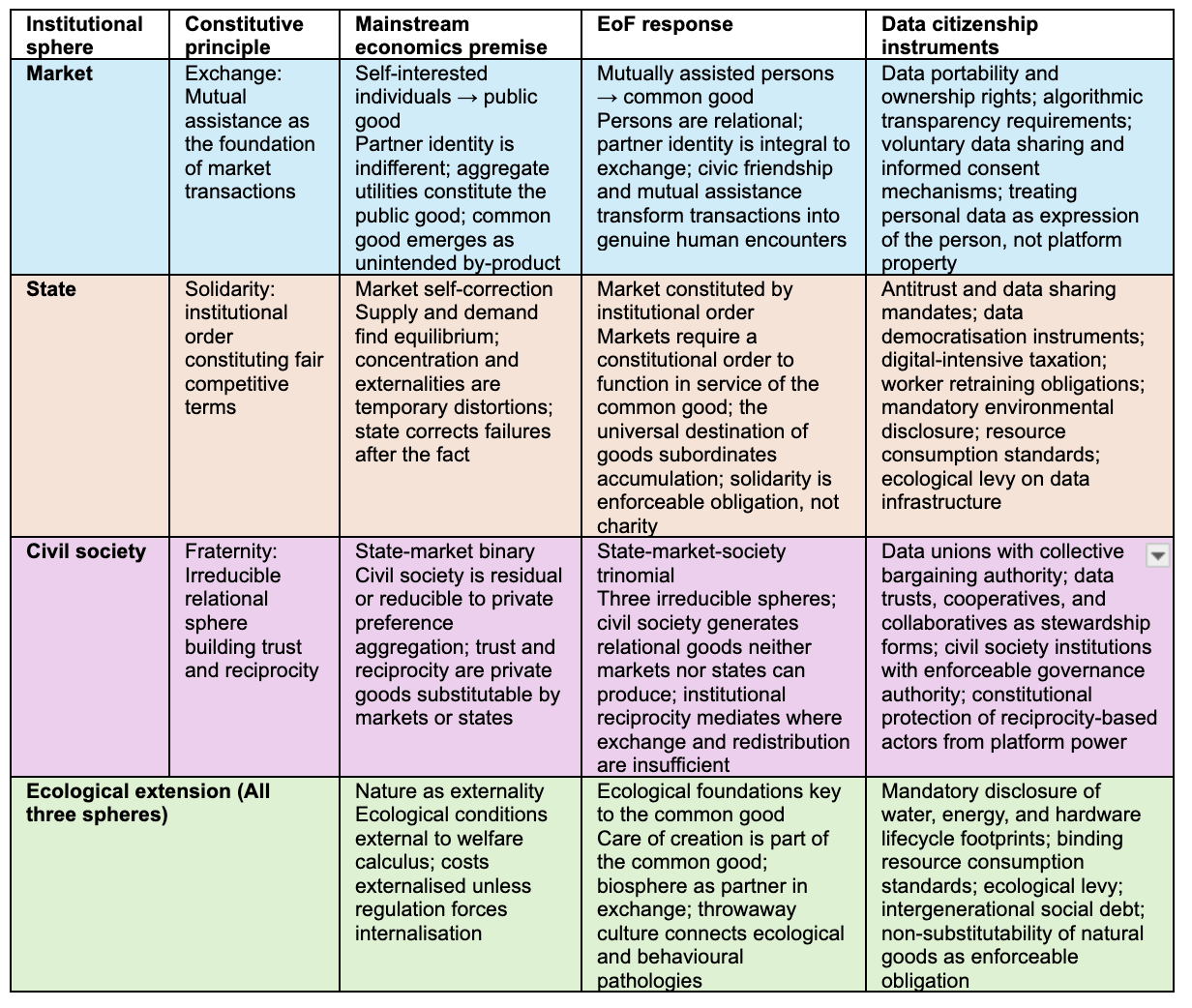
The framework does not propose a corrective to data capitalism. It proposes a constitutional alternative to the state-market logic that sustains it, with intellectual roots in a tradition of economic thought that predates, and has always contested, the premises that data capitalism now pushes to their limit.
What the verdict means
The Los Angeles verdict matters not because it resolves the problem but because it names it. For the first time, a court has found that the harm caused by platform design is not an unfortunate side effect of a neutral technology. It is a foreseeable and intended consequence of an architecture designed to convert behavioural vulnerability into revenue.
The Economy of Francesco holds that an economy organised around the indifference of partner identity, the suppression of mutual assistance, and the externalisation of cost onto the weak and the voiceless is not a well-functioning market in need of correction. It is a disordered one in need of a different foundation. That foundation already exists. The task now is to build with it.
Juan Carlos Mondragón Quintana
Mondragón Quintana is Lecturer in International Business Policy at the University of Bristol Business School, where he directs the BSc in International Business Management. He holds a PhD in Global Political Economy from the University of Bristol, a Master in Public Administration from Harvard, and a Master in Public Policy from FLACSO-Mexico. His research addresses global capitalism, innovation systems, multinational enterprises, and common good ethics. His most recent book, Innovation Systems from Below, was published in 2026 (Palgrave Macmillan). He is a Fellow of the Higher Education Academy and was an Economy of Francesco Academy fellow from 2023 to 2026.