
The Electoral Effects of Conditional Cash Transfers
by Erick Baumgartner
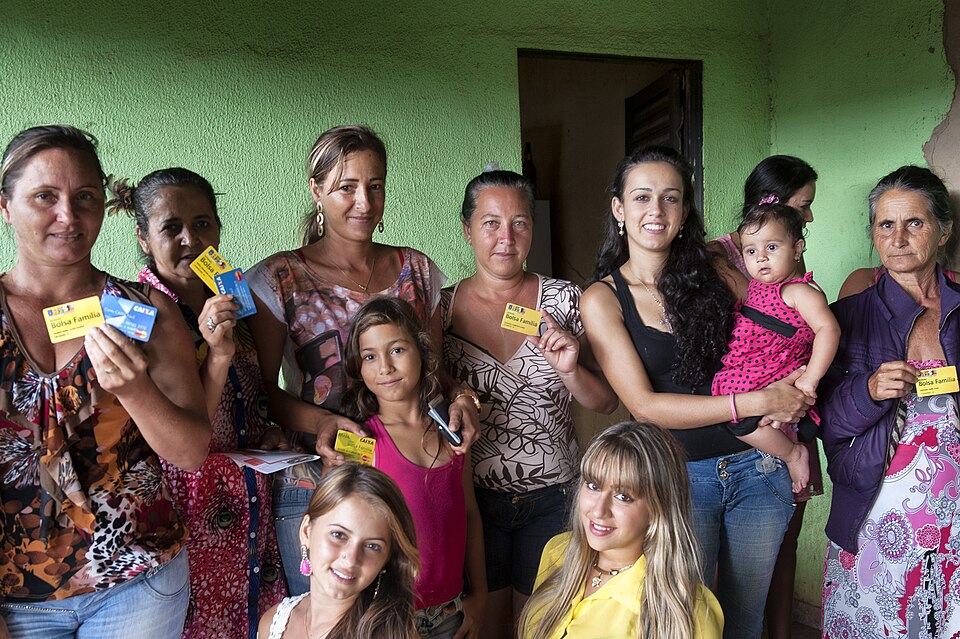
Photo: Ministério do Desenvolvimento Social – Licensed: Creative Commons
Do voters respond to cash-transfer programs by increasing political support? In Brazil, expanded benefits increased turnout, but produced little durable electoral reward for incumbents. Benefit losses, however, appear to lead to electoral punishment.
Conditional Cash Transfer (CCT) programs have been introduced in several countries in the last decades, with pioneering programs in Brazil and Mexico in the 1990s leading to its adoption in more than 50 countries throughout the world by 2013 (World Bank, 2014). These initiatives have led to several improvements regarding health, educational and economic outcomes, both in the short and in the long term (Baird et al., 2014; Garcı́a and Saavedra, 2017; Millán et al., 2019).
While the benefits of CCTs are well established, the literature on the electoral gains derived from CCT implementation has found varying results regarding the response from voters after its introduction.
A metastudy by Araújo (2021) finds generally positive impacts from CCTs on incumbents’ vote share, but articles such as Imai et al. (2020) for the case of Mexico document no effects on incumbent support or even electoral turnout, a result rationalized by the authors as driven by the programmatic nature of the policy introduction, preventing the political ownership of the measure by a single party.
In this article, we study whether Brazil’s CCT program, Bolsa-Família, led to higher incumbent support both at the federal and at the local level by exploiting a 2009 change in the federal methodology used to estimate poverty, leading to changes in the quotas for the number of beneficiaries allocated to each municipality. The central contribution is that this change created variation across municipalities that was plausibly unrelated to local politics or unobserved trends in the expansion of the program, allowing the paper to move beyond simple comparisons between places with more or fewer beneficiaries. Our main result shows that the positive shock substantially increased program exposure and raised presidential-election turnout, but it produced weaker evidence of durable electoral gains for the incumbent party, state-level left parties, or local incumbents. In addition, we also perform an analysis of a negative shock, based on 2013 removals from the program, which suggests more asymmetric political behavior: benefit losses appear to generate clearer punishment than benefit gains generate reward.
The positive shock comes from the identification strategy introduced by Gerard et al., (2025). Earlier quotas for the CCT beneficiaries at the municipal level were based on the 2000 Census and state-level PNAD estimates. In 2009, the government adopted a new small-area poverty-estimation method based on PNAD 2006, while simultaneously expanding Bolsa Família’s national target from roughly 11.1 to 13.7 million families. The paper constructs a counterfactual quota using the old methodology and defines the shock as the difference between the new and counterfactual quotas: we are de facto identifying municipalities that received a beneficiary boost driven solely by a methodological change, and not by any unobservable characteristic or political influence. Municipalities above the median of this shock are treated as positively affected. The shock has a clear effect on treated municipalities, leading them to 13% higher beneficiary levels, with program coverage increasing by around 4 percentage points immediately after the reform and remaining higher, though declining over time. This contrasts to our weak set of electoral results, showing that they are not the result of a weak policy shock: the transfer expansion was real and considerable.
At the presidential level, the paper finds only weak evidence that the expansion increased support for the incumbent party. In first-round presidential elections, the event-study estimates are small and statistically insignificant in the long run: the 2010 coefficient ranges between 0.2 and 0.3 percentage points depending on specification, and the 2014 coefficient is similarly close to zero. The same pattern arises in second-round elections, with estimates even closer to zero. This analysis relies on an event-study that studies all periods jointly, while a second specification focused on cross-sectional variation based on a specification comparing post-reform outcomes while controlling for pre-reform levels (ANCOVA) shows a slightly larger short-run association in 2010 (around 0.4 and 0.5 percentage points without full controls) but this falls to about 0.2 percentage points and loses significance once controls are included. Even when taking the stronger estimated effects for presidential incumbent advantage into account, they are still concentrated in the short term and smaller than prior observational estimates for Brazil.
The expansion did, however, increase voter participation in the first presidential election after the shock. The event-study without controls shows some pre-trend concerns because positively affected municipalities were larger and growing in a faster pace, but once pre-treatment controls are included, placebo coefficients collapse toward zero while the 2010 turnout effect remains positive and statistically significant. The second set of results (ANCOVA) reinforce this: in 2010, treated municipalities show about a 0.3 percentage-point increase in turnout in the fully controlled specification. The CCT expansion mobilized voters, but not in a way that translated mechanically into votes for the incumbent party. One way to rationalize these findings is through the stronger ties created by the program between governmental institutions and beneficiaries, leading to increased electoral participation.
Another interesting result is that gubernatorial elections show null effects across the board, with even smaller coefficients than the presidential election, though both of these votes were cast at the same time. These results are consistent with the fact that, even if we accept the presidential point estimates as evidence of some incumbency effect, this did not spill-over into lower levels of government, with no increase in gubernatorial vote shares of the incumbent party or any left-wing party more broadly. Across event-study and ANCOVA specifications, estimates are close to zero and statistically insignificant. The municipal-level results are also null. Since the choice to run for reelection is endogenous, we focus our analysis on unconditional regressions of incumbent and Workers’ Party vote shares and also on the Regression Discontinuity design proposed by Klašnja and Titiunik (2017) to assess incumbency penalties (and whether the CCT expansion decreased this penalty, benefiting incumbents). All estimates for mayoral elections in 2012 and 2016 are again near zero. The shock also did not affect whether the Workers’ Party ran mayoral candidates, reducing concern that the null is driven by endogenous candidacy decisions. In the cross-sectional specifications, the coefficients remain small and insignificant.
In a final step, we also check for the symmetry of these incentives by assessing a negative shock. It studies the 2013 eligibility review that removed more than 700,000 families, expanding on the results of Frey et al. (2021). Since this was not performed quasi-randomly, we view this as observational evidence. Before exclusion, electoral sections with more future exclusions had higher Workers’ Party mayoral vote shares in 2012. After exclusion, however, this correlation disappears in 2016 and 2020. More strikingly, areas with more exclusions show a small but significant increase in blank or null votes in 2016. This suggests that benefit losses, or the revelation of mistargeting, generated political discontent.
The paper’s results show a setting where positive CCT expansions lead to weak electoral returns, in a similar spirit to Imai et al. (2020), finding estimates for the presidential election below what was previously estimated (Zucco, 2013). Bolsa Família increased participation but did not reliably increase incumbent support, with suggestive evidence for the presidential election in the short term but no gains for gubernatorial and mayoral elections. Exclusions, however, seem to lead to responses by voters, who decrease incumbent support and increase blank votes.
Erick Baumgartner
2025-2026 EoF Academy Fellow