Good Debt, Bad Debt: How Paid Family Leave Shapes Intra-Household Borrowing After Childbirth
by Tracey Freiberg and Ning Li
My research, co-authored with Ning Li (Texas Woman’s University in Denton, TX), investigates a critical question at the intersection of social insurance and household stability: How do paid family leave policies shape the way new parents manage debt?

In today’s economy, paid family leave (PFL) represents a critical component of the social safety net, designed to protect families from the economic instability that can arise during significant care events, such as the birth of a child. Because care work often acts as a financial “shock absorber” that families must manage largely on their own, PFL programs aim to mitigate the burden of time-intensive caregiving by providing two functions: wage replacement and job protection. By maintaining income streams during periods of reduced workforce participation, PFL policies are intended to shield households from the pressure to accumulate debt to cover immediate expenses, thereby serving as a preventative measure to ensure that necessary caregiving responsibilities do not permanently compromise long-term household economic well-being.
The American case for paid family leave is unique across its global peers as there is no federal policy — there is an unpaid program called the Family Medical Leave Act (FMLA) that provides unpaid job protection for eligible workers. Further, the state-level programs are gender neutral, which, in the name of equality, provides the benefits for any eligible worker — another notable change from other OECD countries. Table 1 below shows the state programs relevant for the time line of our study, along with basic benefits.
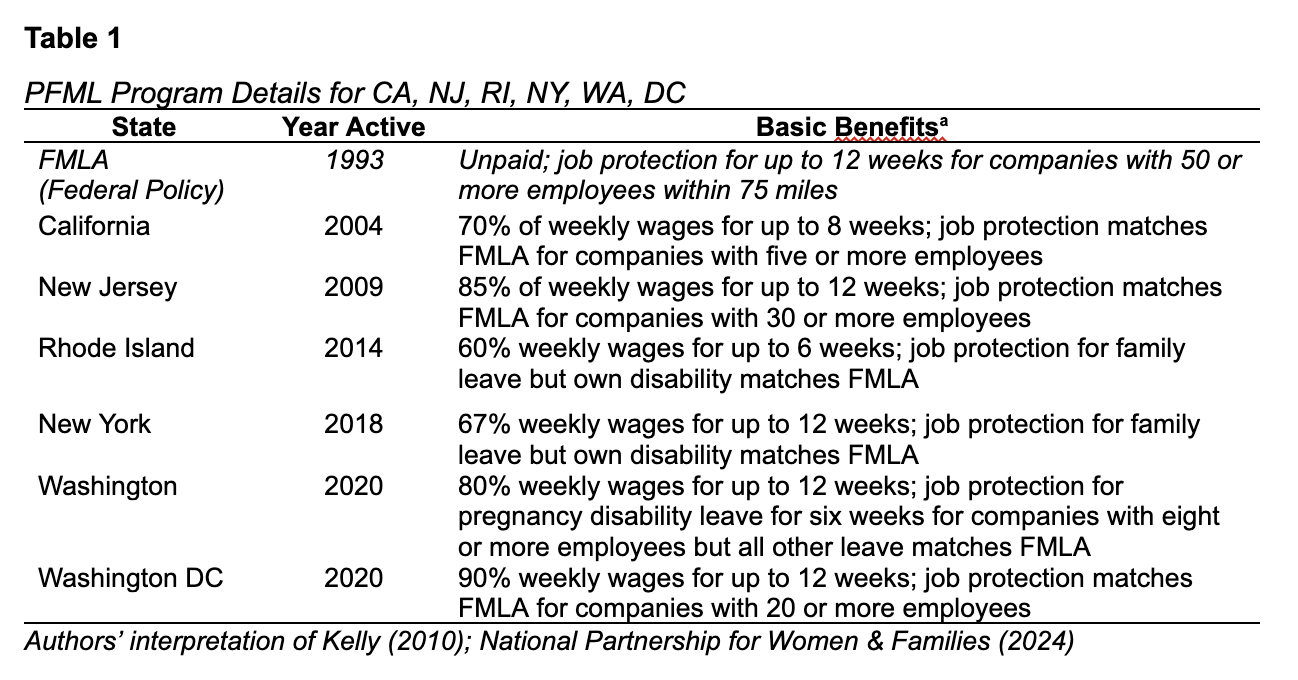
(a) Where applicable, the benefits reflect the most recent expansion, which are typically more generous wage replacements and/or leave duration.
To understand these effects, we first distinguish between two types of debt. Borrowing from household finance scholars, we use the terms “good” and “bad” debt, though these are imperfect labels. As such,
- “Good” (Secured) Debt is debt backed by collateral, such as a mortgage, auto loan, and (personal) business loans. It is generally associated with long-term asset accumulation—building equity in a home that increases household wealth over time.
- “Bad” (Unsecured) Debt is debt that does not require collateral, such as credit cards, medical bills, or student loans. Unsecured debt is generally associated with filling short-term gaps to meet immediate needs, often at higher interest rates.
Our study uses a difference-in-difference empirical strategy across nine measurements of debt from the Survey of Income Program Participation (SIPP) from the U.S. Census data from 2013–2020 to reveal that paid leave programs function may facilitate wealth-building for certain families. From the SIPP, secured debt includes:
- Home,
- Vehicle,
- Rental properties,
- Other real estate,
- Debt against (personal) businesses;
whereas unsecured debt includes:
- Credit cards,
- Educational debt (student loans),
- Other debts,
- Medical bills not paid in full.
Primarily, the most consistent finding across our models is that new parents, without taking gender into consideration, that live in states with paid family leave are more likely to accumulate home debt. When we account for labor market participation, this trend becomes even clearer: paid leave seemingly enables the financial confidence for growing families to purchase homes or upgrade their housing, effectively using social insurance to transition into asset-building behaviors, which the literature suggests is common for new families. The wealth-accumulation results are particularly pronounced for married couples and, when we control for employment, for working married mothers as well.
However, our findings also uncovered a more concerning trend for a specific subset of the population: working, non-married mothers. While paid leave seems to help with rental property ownership for new non-married mothers living in a paid leave state, it does not erase the immediate financial pressures of early parenthood. We found that unmarried, working new mothers in paid leave states are significantly more likely to rely on what the SIPP classifies as “other” debt—a catch-all category that includes loans from credit unions or informal borrowing from friends and family.
Our results suggest that while the American paid leave model may enable those in traditional, stable employment arrangements (often married, full-time workers), it may fall short for more vulnerable populations. For these non-married new mothers, the program alone is not sufficient to cover the gap, and they are forced to turn to non-traditional borrowing to manage the high costs of childcare, medical expenses, and daily living.
Our research challenges the “one-size-fits-all” approach of current gender-neutral paid leave policies. While these policies are technically accessible to all workers who meet the eligibility requirements, which differ state by state, our results show they produce differentiated outcomes based on gender, marital status, and labor market attachment. Primarily, we find:
- Marriage emulates a Financial Multiplier: We found that marriage acts as a catalyst for “good” debt (home ownership) among new parents. The safety net of paid leave appears to work in tandem with the stability of marriage to encourage wealth accumulation.
- The Social Insurance Gap: The reliance on informal or “bad” debt by non-married working mothers suggests that current paid leave benefits may be too complicated to access, or provide insufficient wage replacement, to fully alleviate financial strain for those who lack a secondary earner or institutional support.
- The Gendered Reality of Care: Despite gender-neutral policy language in the US, the responsibility of care still falls disproportionately on women, replicating centuries of global gender norms. Our study highlights that until policies account for the intersection of gender, marital status, job quality, and other intersectional measures, American PFL programs may inadvertently reinforce economic inequality rather than solve it.
The findings from our study underscore the importance of paid family leave, particularly for its role in facilitating household financial stability during the transition to parenthood. Our results demonstrate that access to paid family leave significantly encourages “good” debt accumulation, specifically home debt, suggesting that these programs help growing families build long-term wealth and secure larger living spaces. Furthermore, while the emergence of “other” (unsecured) debt, particularly among non-married working mothers, reveals that while paid leave policies may provide support, they do not entirely eliminate financial vulnerabilities, suggesting that the effectiveness of these programs relies heavily on intersectional factors like marital and labor market status.
Future policy should ensure that the “safety net” programs actually reach the families who need it most. As state-level programs continue to expand in the US, with Virginia passing their own state-level program in April 2026, our research offers a clear lesson: the design of paid leave matters.
Tracey Freiberg
She is an Assistant Professor of Economics at the Tobin College of Business at St. John’s University. She holds a PhD in Public and Urban Policy from the Milano School of Policy, Management, and Environment at The New School. She focuses on labor economics, policy, and benefits, with special attention to gender and other traditionally marginalized communities. Her research is interdisciplinary in nature: blend of applied economics and policy analysis with a focus on stratified outcomes federal- and state-level American labor policies. Outside of academia, she has over 10 years of experience in insurance, financial services, consulting, and research.
2025-2026 EoF Academy Fellow