How Fascist Italy Distributed Land in the Pontine Marshes: Rules, Reality, and the Limits of Planning
by Francesco Romagnoli
In the 1930s, the Italian Fascist regime launched one of its most ambitious rural policies: the reclamation and colonization of the Pontine Marshes, a large wetland area south of Rome. The project transformed a territory long associated with malaria, poor drainage, and low agricultural productivity into a new rural landscape made of farms, villages, roads, canals, and newly founded towns such as Littoria, today’s Latina. The official story told by the regime was one of scientific planning and rational modernization. Land would be reclaimed, divided into farms, and assigned to carefully selected settler families. These families, many of them recruited from rural areas of northern Italy, would move to the Pontine area and cultivate the land. Over time, they were promised the possibility of becoming owners of the farms they worked on.
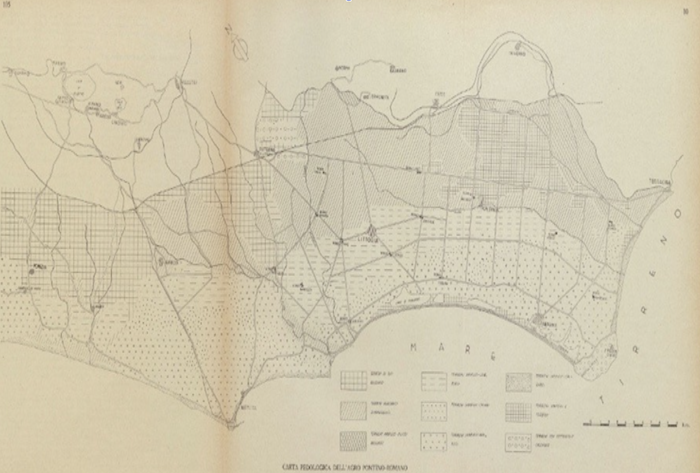
[Figure – Pontine Ager: Soil Map (Mazzocchi Alemanni 1940)]
My study, Land, Labor, and the State: Allocation Mechanisms in Fascist Italy’s Pontine Ager Colonization Scheme (1932-1943), investigates a simple but important question: how was land actually assigned to these families? More specifically, did the fascist administration follow the technical rules it claimed to use, or was the allocation of land shaped by other practical and administrative factors?
This question matters because land reform is often studied in terms of its political causes or long-term consequences. We know a lot about why governments redistribute land, and we know that land reforms can affect inequality, agricultural productivity, rural poverty, and political control. But we know much less about the intermediate step: the actual process through which land is matched to beneficiaries. Who receives which plot? How large is it? What criteria are applied? And do formal rules survive when a policy is implemented on the ground?
The Pontine case is especially useful for answering these questions because the regime publicly endorsed a clear allocation principle known as the Tommasi Method. This method aimed to match the size of each farm to two main factors: the quality of the land and the labor capacity of the settler household. In principle, a family with more available workers could cultivate a larger farm. At the same time, land of poorer quality could be assigned in larger plots to compensate for lower productivity. The goal was to create farms that were different in size but broadly comparable in productive potential.
In theory, this was a technocratic system: a planned, rule-based method for distributing land. In practice, the question is whether it was actually applied. To study this, I use archival and administrative data on settler families and land assignments in the Pontine area. The data include information on the families who migrated to the region, their place of origin, the municipality where they were settled, the year of arrival, and the size of the farm assigned to them. The analysis focuses especially on first assignments, because these are the best available evidence of the original allocation mechanism. Later reassignments are also examined as a robustness check, but they are more difficult to interpret because they may reflect vacancies, family replacements, repatriations, or already existing plot sizes.
The evidence shows that land allocation was not random. The administration clearly paid attention to territory. Plot sizes differed substantially across municipalities, and these differences were often consistent with local land quality. For example, areas with poorer or more difficult soil could receive larger farms, while more fertile areas could be divided into smaller plots. This suggests that the land-quality component of the Tommasi logic was taken seriously, at least at a broad territorial level.
However, the household-based component of the method appears much weaker. Larger families did receive somewhat larger plots, but the relationship was modest. Families of similar size often received very different amounts of land, while families with different labor capacity could receive similar plots. In statistical terms, family size had a positive association with plot size, but the effect was small compared with the large differences across municipalities.
This means that the allocation process was shaped much more by where and when a family was settled than by a precise household-by-household calculation. Municipality mattered greatly. Settlement timing also mattered: assignments made in different phases of the colonization program followed somewhat different patterns. In particular, later phases show evidence of changing ideas about the efficient size of farms. Some municipalities settled later, such as Aprilia and Pomezia, tended to have larger plots, reflecting evolving views within the administration.
The study also finds that family size was not evenly distributed across destinations. Larger and smaller households were not spread uniformly across the Pontine municipalities. This suggests that household characteristics may have influenced allocation not only at the final stage, when a specific plot was assigned, but also earlier, when families were directed toward particular areas. In other words, land assignment was a two-step process: families were first placed into municipalities and settlement phases, and only then matched to specific farms.
The evidence from later reassignments strengthens this interpretation. In these cases, family size matters even less once the municipality is considered. This is understandable: when a farm became available after the first assignment, administrators were not necessarily redesigning the plot for a new household. They were assigning an already existing farm to a replacement family. As a result, the size of the plot depended largely on the municipality and on the existing stock of farms, rather than on the characteristics of the incoming household.
Overall, the findings suggest that the Fascist land allocation system in the Pontine Marshes was partially planned but unevenly implemented. The Tommasi Method provided a formal benchmark and probably influenced administrative thinking. Yet the actual distribution of land did not follow a precise, individualized application of the method. Instead, implementation worked through broader and coarser channels: soil conditions, municipal boundaries, settlement phases, the availability of reclaimed land, and the practical pressures of moving thousands of families into a newly transformed territory.
This conclusion is important for how we understand state-led reform more generally. Authoritarian regimes often present themselves as capable of imposing order from above. The Fascist regime certainly described the Pontine project as a triumph of centralized planning. But even in this highly controlled setting, implementation was constrained by information, timing, local conditions, and administrative capacity. The gap between the formal rule and the realized allocation was not simply chaos or arbitrariness. It was patterned: the state simplified its own rules and applied them through territorial and temporal categories rather than through precise individual matching.
The Pontine case therefore offers a broader lesson. Land reform is not only about laws, ideology, or final outcomes. It is also about the administrative process that connects policy design to people’s lives. Understanding who received which land, and why, helps us better evaluate the real functioning of redistribution policies. In the Pontine Marshes, the regime promised a scientific matching of families and land. What emerged was a more imperfect but still structured system, shaped by the limits of planning on the ground.
Francesco Romagnoli
PhD Candidate in Business and Economic History at Bocconi University, his research examines how small and medium-sized enterprises (SMEs) navigate periods of economic and political closure, with evidence from interwar Italy.
He also studies the role of state intervention in shaping firm strategy and outcomes under deglobalization, and the impact of state policy on wealth and income distribution.
2025-2026 EoF Academy Fellow