The Oxfam Report ‘Resisting the Rule of the Rich’
Commentary by the EoF Public Policy Group
Oxfam’s 2026 report, The Choice: Oligarchy or Democracy?, raises an urgent and consequential question for contemporary political economy. Drawing on recent data, the report documents the rapid acceleration of billionaire wealth accumulation and argues that extreme economic concentration increasingly translates into political influence. It highlights how the erosion of democratic checks and balances, the weakening of media independence, and the restriction of civil liberties are correlated with rising economic inequality. In this sense, the report frames today’s challenge not merely as an issue of distributive justice, but as a structural threat to democratic governance.
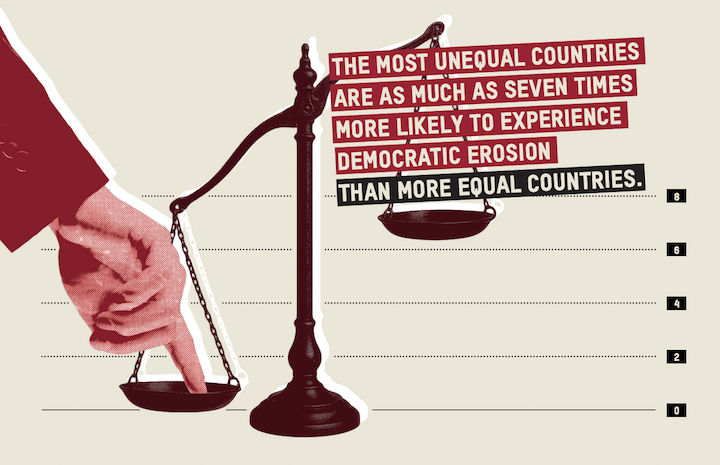
It is important, however, to distinguish between inequality as such and inequality that becomes destabilizing. A certain degree of economic and wealth differentiation is inherent to market economies and can, under appropriate institutional conditions, enhance efficiency. Differential returns to innovation, entrepreneurship, and risk-taking often drive productivity growth and structural transformation. Yet when economic and wealth disparities become excessive and self-reinforcing, they may generate inefficiencies of their own. These include distorted resource allocation, barriers to social mobility, underinvestment in public goods, and the intensification of social conflict. The concern raised by Oxfam is that the global economy may be drifting from productive differentiation toward entrenched concentration.
Capital functions as the fuel of modern economic systems. Where it accumulates shapes the trajectory of development.
This raises a set of fundamental policy questions. Is capital flowing toward sectors that reflect broad social demand? Does wealth concentration correspond to areas that embody advanced productive forces and long-term innovation? Does it contribute to overall social welfare, or does it disproportionately benefit a narrow group while leaving living standards stagnant or declining for the majority? These are not ideological questions; they are core issues of economic governance. Policymakers must assess whether wealth accumulation aligns with broad-based development or whether it signals structural imbalances within the economy.
A related and equally pressing concern is whether those who command substantial economic resources are able to convert that power into sustained political influence. If wealth is systematically used to shape legislation, regulatory frameworks, electoral outcomes, or public discourse in ways that reinforce existing advantages, a cumulative dynamic may emerge. Policies that favor capital concentration can further amplify that concentration, generating a feedback loop reminiscent of the “Matthew effect.” Over time, such dynamics risk entrenching political inequality alongside economic inequality. This possibility is not unique to any single country; it represents a challenge inherent in modern capitalist democracies.
In this respect, Oxfam’s report performs an important function. It brings to the forefront a question that is often politically sensitive: to what extent is democratic governance compatible with extreme wealth concentration? In many contexts, this issue remains underexamined precisely because political systems themselves may be partially dependent on concentrated financial support. The report proposes a series of concrete institutional measures, including more effective taxation of the super-rich, stricter regulation of lobbying and revolving doors, limitations on campaign financing, and stronger guarantees of media independence and algorithmic transparency. These recommendations operate within the existing institutional framework and aim to correct imbalances without fundamentally altering the market system.
Yet a deeper question remains. Within the framework of a modern market economy, how can societies preserve efficiency and dynamism while preventing the excessive concentration of economic and political power? Addressing this question requires moving beyond moral critique toward institutional design.
First, greater transparency in campaign financing deserves emphasis. Rather than relying solely on prohibitions, strengthening public funding mechanisms and ensuring comprehensive disclosure of political donations may reduce the dependency of elected officials on concentrated private capital while maintaining open political participation.
Second, media pluralism should be addressed not only through content regulation or algorithmic transparency, but also through structural ownership considerations. Limiting excessive media concentration and cross-sector capital control can help prevent the consolidation of informational power in the hands of a small number of actors.
Third, taxation of extreme wealth requires careful technical design and international coordination. Wealth taxes, capital gains taxation, and inheritance taxation each raise issues of valuation, mobility, and avoidance. Without cross-border cooperation, unilateral measures risk capital flight and regulatory arbitrage. International coordination is therefore crucial to ensuring both effectiveness and economic stability.
Fourth, competition policy plays an underappreciated role in this debate. Market concentration often precedes wealth concentration. Strengthening antitrust enforcement and scrutinizing mergers in key sectors can limit the structural sources of excessive accumulation. By preserving competitive market structures, governments may reduce the pace at which economic power consolidates, thereby easing downstream political pressures.
These considerations suggest that markets do not inevitably produce democratic erosion. The critical variable lies in institutional mediation: how effectively political systems regulate the interaction between economic power and political authority. If institutional safeguards are robust, inequality may remain compatible with democratic stability. If safeguards weaken, economic disparities can gradually translate into political domination.
Oxfam’s report underscores the urgency of confronting this tension. Whether one agrees with all of its prescriptions or not, the underlying issue it identifies is central to the future of democratic governance. The challenge is not simply to reduce inequality, but to design institutions capable of balancing economic dynamism with political equality. In this sense, the choice is not between markets and democracy, but between institutional arrangements that reconcile them and those that allow one to undermine the other.