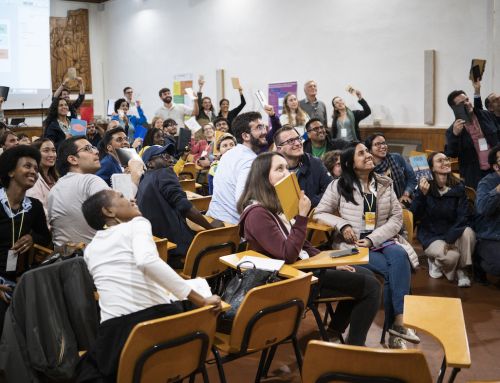
The Economy of Francesco Global Event 2025 will feature 15 workshops on the second day of the event, 29 November, from 11 a.m. to 1 p.m. These workshops have been co-designed by community members, including the 12 Villages of the Economy of Francesco, senior advisors, and partners whose missions align with EoF.
Each session provides participants with a space for reflection and action on key dimensions of our economies, communities, and societies—such as labor, lifestyles, commons, finance, inequalities, and energy—while collectively exploring how to restart the economy guided by the principles of fraternity, the common good, and care.
Through participatory activities, collaborative labs, and creative outputs, the workshops generate both ideas and practical proposals that can inspire policy, organizational change, and everyday action, offering participants concrete tools to transform their communities and the economic systems they are part of — in line with a vision for the future that is relational, ethically grounded, and attentive to the interconnectedness of all beings.
1. Co-creating Our Agrifood Systems
Agriculture & Justice Village
Coordinators: Federica Ammaturo, Catalina Hinojosa Lopez, Perla Tannous, Ariel Molina and Gabriela Consolaro
This workshop invites participants to experience the joy and depth of co-working and co-creating while addressing the complex issues and challenges facing today’s agrifood systems. Together, we will explore how agriculture and justice can be reimagined through shared reflection, systemic change and inclusive dialogue. Based on Otto Scharmer’s Theory U, this session provides a framework for personal, organisational and societal transformation through deep listening, co-sensing and collective action. Theory U will guide us on an inward journey to open our minds, hearts, and wills so that we can move forward in connection with ourselves, each other, and the Earth. This will be a path of opening up to connect and co-create.
2. An interactive session on gift-giving dynamics in business
Management & Gift Village
Coordinators: Vincenzo Porzio, Roberta Sferrazzo, Anouk Grevin, Enrico Marcazzan, Ludovica Montesanto, Caren Rodrigues, Gabriele Sarnarni, Martina Tafuro and Ricardo Zózimo
This 90-minute interactive workshop explores management as gift, highlighting how gift-giving logics can reshape organizations and align them with the Economy of Francesco (EoF) ideals and the Jubilee Economy’s core pillars. The session begins with a theoretical introduction by Prof. Anouk Grevin and Prof. Ricardo Zozimo, who will present philosophical, anthropological, and sociological foundations of gift and its application in business and social entrepreneurship. Participants will then engage in an interactive game led by Prof. Anouk Grevin and Prof. Roberta Sferrazzo, designed to translate research insights into actionable practices while co-creating a Global Map of the Jubilee Economy. The final part, presented by Vincenzo Porzio, examines the MUDD Case in Naples, Italy—an innovative initiative transforming churches into inclusive cultural spaces, fostering community, creativity, and youth engagement. Through theory, practice, and lived experience, the workshop invites researchers, changemakers, and entrepreneurs to integrate gift-based principles into their professional and organizational contexts.
3. Hack your purpose
Vocation & Profit Village
Coordinators: María Luz Chanampa, Juan Felipe Borge, Claudio Trapani, Francesco Tronci and Francisco Antonio Chavarría Solano.
This workshop offers an immersive experience of village life, inviting participants to explore the intersection between personal purpose and communal action. Through a combination of individual reflection and group activities, coordinators guide participants in taking the first steps toward discovering how their unique talents and aspirations can translate into meaningful contributions within their communities. The workshop emphasizes the power of everyday bonds, fraternity, and shared responsibility as sources of inspiration and transformation, especially for young people navigating a society in need of economic and social renewal. Inspired by Pope Francis’ call to “give a soul back to the economy,” the village setting provides a dynamic space for cultivating synergy across all dimensions of the person—personal, relational, and societal—empowering participants to become active agents of change.
4. Building ecosystems of dignity and inclusion
Work & Care Village
Coordinators: Melissa Mejía Florez, Francesca Paradiso Casale, Giorgia Nigri and Tracey Freiberg
This workshop invites all villagers to co-create solutions for more humane, inclusive, and sustainable workplaces. Participants explore, through collective reflection and action, how care can be embedded at the center of work, addressing the urgent need for practices that dignify workers, foster economic renewal, and promote social inclusion. The approach is dynamic, hands-on, and designed to break old patterns while generating actionable ideas for policy and organizational transformation.
5. A Way Of Life: Rethinking Our Integral Growth and Wellbeing
Life & Lifestyle Village
Coordinators: Maria José Paez and Alejandro Cañadas
The idea of this workshop is to introduce the “Laudato Si’ Compass,” a practical framework to help participants reconnect their mental, emotional, material, social, and spiritual dimensions through the integral approach of Laudato Si’, inspired by St. Francis of Assisi.
The journey unfolds through three thematic moments, each designed to engage participants in the concrete application of these principles to everyday life:
- Sustainable and Responsible Consumption
- Empathic Listening to Create an Economy of “Encuentro” (Communion)
- Optimal Work: Focusing on What Really Matters
Participants will experience all three themes, reflecting and acting together to generate insights and proposals that can be applied in personal, community, and professional contexts.
6. The Marketplace of the Common Good
Policies for Happiness Village
Coordinators: Si Chun Lam
The Marketplace of the Common Good is an interactive workshop which explores happiness as a shared societal goal. Inspired by Bruni (2005), Bartolini (2016), and the projects of the Economy of Francesco’s Policies for Happiness Village, participants represent diverse stakeholder groups and engage in structured rounds of resource exchange. Through collaborative negotiation and identification of policy levers, teams co-create an Inclusive Map of Happiness — a strategic blueprint for collective wellbeing. The session demonstrates that sustainable happiness arises not from isolated gains, but from mutual flourishing, offering practical insights for implementing Policies for Happiness across sectors.
7. Addressing Inequality: Jubilee Responses to Global Inequality and Environmental Crisis
CO2 of Inequalities Village
Coordinators: Tony Guidotti and Liam Finn (Caritas Internationalis)
Pope Francis reminded us in 2022 that “Carbon dioxide is not the only pollution that kills; inequality also fatally damages our planet.” The CO2 of Inequalities Village exists at the intersection of two ideas: the Earth must be allowed to breathe, and all people must be freed from exploitation, excessive debt, and other forms of inequality. This workshop, co-sponsored by the CO2 of Inequalities village and Caritas Internationalis, builds on these concepts, exploring the interconnected forms of inequality present in our economy and the actions that are necessary to remedy them. During this interactive session, we will share our experiences with inequality, learn from others’ perspectives, and collaborate on concrete ways the Economy of Francesco can bring jubilee – liberation, restoration, and rest – to transform the economic system and our communities.
8. Flip the Switch : Game On for Energy Justice
Energy & Poverty Village
Coordinators: Alexis Ferte, Jules Gallazzini and Madeleine Ouss
How to build a future where energy serves everyone?
In this interactive workshop, you’ll take part in two games: one explores the power of low-tech and high-tech solutions, the other challenges you to build consensus on fair energy use. Inspired by the values of The Economy of Francesco, we’ll play, reflect, and reimagine energy through the lens of justice, simplicity, and care for our common home.
9. Banks with a Soul: serving local communities for the Common Good
Finance & Humanity Village
Coordinators: Francesco Polo, Fabian Storti (Federazione del Nord Est), Silvia Cerlenco and Ilaria Manti (Federcasse)
The workshop introduces participants to the origins of mutual banks, from the Franciscan experience of the “Monti di Pietà” to the current model of credit cooperatives spread worldwide. It also presents the key features of the Italian model of Credito Cooperativo. The goal of the workshop is to co-design practical actions to further promote the culture of cooperative banking within local communities, identify elements that may appeal to younger generations in embracing this way of practicing finance with a soul, and understand why the local presence of banks is crucial in supporting territories—especially in more fragile inland areas—as institutions that carry public interest and contribute to the common good.
10. From Extractive to Non-Extractive Business Models
Business in Transition Village
Coordinators: Bruno Petrušić, Melanie Rieback, Dawn Carpenter and Romain Buquet (UNIAPAC)
The global economy remains dominated by extractive business models that prioritize short-term profits and shareholder primacy, often at the expense of workers, communities, and the environment. The Economy of Francesco calls for alternatives — businesses rooted in dignity, solidarity, and the common good.
This workshop explores how businesses can transition from extractive to non-extractive models. Participants will be introduced to steward-ownership as a replicable governance framework, learn from real-world case studies, and experiment with practical tools such as the Business Model Canvas. In addition to structural and organizational pathways, the workshop will highlight the spiritual dimension of business transformation, introducing contemplative entrepreneurship and practices of discernment. UNIAPAC will bring in the perspective of business executives engaged in global transition efforts.
11. Steps for Peace: Building Peace Brick by Brick in Business and Communities
Business & Peace Village
Coordinators: Giovana Batista, Natalia Teguhputri, Ricardo Flores Chong, Daniele Lonardo (UCID) and Benedetto Delle Site (UCID)
Peace is not an abstract dream but a process, built step by step in our workplaces, families, and communities. This workshop explores how businesses and professionals can take small, concrete actions to foster peace and cohesion. Inspired by the Donut Economy, the vision of St. Francis of Assisi, and the words of Pope Francis, participants will reflect on their own contexts and discover how business can be a driver of peace. Through interactive group activities, participants will design “bricks” and “seeds” of peace that represent concrete actions. At the end, each group will present a Step for Peace Statement, and all will be combined into a Collective Declaration of Peace. This workshop aims to inspire practical change and highlight the essential role of business in building a culture of peace within the Economy of Francesco.
12. Redesigning the Economy with Women’s Voices: Empowerment, Justice and Care
Women for Economy Village
Coordinators: Olena Komisarenko and Lucia Marchegiani
Women are transforming economies worldwide — often quietly and against persistent barriers. This workshop invites participants to imagine an economy where women’s talents, leadership, and care work are fully recognized and valued. Through storytelling, collaborative mapping, and scenario-building, we will uncover how gendered gaps in access to resources, decision-making, and innovation hinder inclusive growth, and co-create strategies to overcome them. Drawing inspiration from women-led enterprises, social innovations, and community initiatives already connected to the Women for Economy network, participants will explore how to integrate care, equity, and creativity into new economic models. The session is hands-on, interactive, and designed to generate a visual map of women-powered economic transformation and 3–5 collective proposals for fairer, more regenerative systems.
13. Key elements to implement a social and solidarity economy project in the global south
Coordinators: Alberto Irezabal and Adriana Gómez-Chico
This workshop is aimed for participants that are interested or are already implementing a social and solidarity economy enterprise/project in the global south. It will allow participants to understand and work around key elements needed for a successful implementation that address the tensions between the territory rhythms and market dynamics.
14. What a Dilemma Session: Bridging Theory and Practice Through Real-Life Dilemmas
Coordinators: Valentina Alarcón and Marcia King
This interactive session invites one participant to share a real-life personal dilemma with a broader community impact. The rest of the group becomes a circle of active listeners—asking thoughtful questions and offering new perspectives to support the presenter.
It’s a powerful experience of empathy, collaboration, and shared learning. By exploring real challenges together, we open space for honest dialogue, deeper understanding, and meaningful action.
The session promotes a learning environment that encourages vulnerability, reflection, and co-creation—key elements for building a culture of peace across cultures, disciplines, and generations.
15. Narrative Capital: Contemporary Parables for Contemporary Times
Coordinator: Stefano Rozzoni
This workshop explores narrative capital in the interaction between economic and literary discourse, in line with the project GRIOT’s Role within the Economy of Francesco (EoF). The discussion will address how stories can embody and perform the ethical values central to EoF’s vision of a new economic culture. Focusing on “contemporary parables for contemporary times,” special attention will be given to the revival of the parable’s original ethical function in contemporary literary production as a creative and critical medium for engaging with current economic, environmental, social, and political crises. The core of the workshop is a collaborative writing activity in which participants will receive prompts to draft short “contemporary parables” inspired by keywords from the EoF Glossary, using fiction to imagine alternative practices and values for the new economy envisioned by EoF.