Interview: Francesca Di Maolo
The Contemporary Relevance of the Franciscan Charism
The Charism Today
Eight hundred years after Saint Francis, what does the Franciscan charism mean today, in concrete terms?
Eight hundred years after the death of Saint Francis, the Franciscan charism retains a rare capacity: to read the present. And today, in concrete terms, it passes first and foremost through fragility. Not to exalt it in the abstract, nor to turn it into an ideology of suffering, but to recognize that precisely there, where humanity is wounded and vulnerable, something decisive about humanity, relationships, and coexistence is revealed.
Fragility is not a marginal element in Francis’s story: it is where his conversion takes shape. Francis does not encounter God outside of concrete life, but within what initially appears bitter, uncomfortable, even repulsive. Embracing the leper is not a simple act of charity: it is the moment of recognition. Distance becomes proximity, fear becomes relationship, and rejection becomes encounter. It is the wounded person who converts him and brings him back to the truth of the Gospel. Bitterness turns into sweetness because his perspective changes.
This is the heart of the Franciscan charism: fragility does not diminish the value of life, but rather dismantles the false standards by which we often judge it. In a time that tends to equate dignity with autonomy, efficiency, and productivity, Francis calls for a reversal. A person’s value does not depend on their strength or functionality. Every life has immense value, and it is from this truth that certain social consequences arise. The Franciscan charism calls for works that place the whole person at the center, a culture of care expressed in relationships, an economy that includes rather than discards, a society that does not view limitations as failures, but as an integral part of the human condition.
This is why Francis continues to speak to us, especially in a world wounded by war, loneliness, inequality, and exclusion, reminding us that true civilization is measured by how we look after the most fragile.
Charism and Care
The Istituto Serafico di Assisi is a place deeply marked by care and inclusion. How does the Franciscan vision take shape in your daily life?
At the Serafico, the Franciscan vision takes shape within a concrete story born of a profound intuition. It was a Franciscan friar, Saint Ludovica of Casoria, who initiated this work, reflecting on the very fragility of Saint Francis, who in the last years of his life was almost completely blind. From this experience, a work was born in Assisi dedicated to the education of the blind and deaf, people who at the time had no access to school. It was an act of extraordinary innovation, not only in terms of charity, but also in terms of social impact.
From the very beginning, therefore, the charism has guided Serafico to respond to unrecognized needs and marginalized fragilities, anticipating solutions where none yet existed. Over time, this same charism has guided us to increasingly open ourselves to the health needs of people with severe disabilities, continuing to stand on that frontier where others retreat.
The Franciscan charism guides us to care for the person in their entirety and within a relationship.
At Serafico, this translates into a precise perspective: children, young people, and persons with disabilities are not passive recipients of care or educational interventions, but active participants in relationships, capable of generating meaning, challenging, and transforming even those who care for them. And from this perspective, caring does not simply mean performing technical tasks, nor intervening on limitations with the illusion of eliminating them: if that were the case, everything incurable would also become uncared for. Caring, however, is something deeper: it means accompanying the person to live a full life. Beyond the technical act of healthcare, we are called to cultivate life and make it flourish through all domensions of existence: art, music, sport, work, science, prayer.
This is the meaning of our mission. The very name, “Serafico,” by which the first friars referred to Francis, evokes a burning love, capable of uplifting and safeguarding life. For us, it means being close to each person not only to support their autonomy, but also to listen to their desires, recognize their preferences, help them express their talents, and participate in life.
Over the years, we have learned that even when the body is immobile, when it seems trapped in darkness, silence, or severe cognitive impairment, there is always an inner life demanding recognition. There is always a desire for connection, a possibility of expression, a longing for the other. And we can become the wings of that flight.
On the wings of fraternity, dignity ceases to be an abstract word and becomes a living experience, and each person can express themselves in their entirety, beyond limitation.
This perspective also transforms the meaning of the work of those who work at Serafico. They are not just healthcare workers: they are builders of justice, because they uphold the fundamental rights of every person; they are builders of democracy, because they work to ensure that no one is excluded; they are peacemakers, because every day they protect the most fragile and defenseless life, demonstrating that peace is born precisely from recognizing the immense value of every life.
But there is an even deeper meaning that has continued to guide our mission for over 155 years: it is the call to cross that threshold that Francis crossed. Even when everything seems difficult or impossible, we are called not to retreat, but to remain on that frontier land where others stop. It is there that we encounter the loneliness of mothers and fathers often invisible to society. It is there that we learn to pause and remain close, because when everything seems futile, there always remains a possibility that never fades: that of being close, of sharing, of embracing one another.
Economy and Vulnerability
In a world often driven by efficiency and performance, what can places like the Serafico teach us about vulnerability and dignity?
Places like the Serafico teach us that vulnerability is not a margin, but a privileged vantage point for understanding reality.
Indeed, it is through fragility that the contradictions of our economic and social system emerge most clearly. We live in an era of extraordinary medical progress and increasing life expectancy, yet inequalities are growing, especially in access to care. This tells us that improving services is not enough: we must question who truly benefits from them and who remains excluded.
Vulnerability challenges a model that tends to standardize needs and measure value in terms of efficiency and performance. But people’s lives are not standard. Every existence is unique, and when a system fails to recognize this, it inevitably generates injustice.
The Serafico experience offers us another starting point: life, in its entirety. Health cannot be reduced to a mere performance, nor treatment to a cost to be contained. Caring for and defending life means building environments where no one is abandoned, especially in moments of greatest fragility. But it also means recognizing that dignity does not depend on functionality: it is a fundamental fact, which concerns every person.
From this perspective, welfare also needs to be rethought: it cannot simply provide standard services for standard needs, but must become generative, capable of activating resources, supporting families, enhancing relationships, and helping people participate in life and express their talents.
Then there’s a profound cultural issue. Our era tends to remove limits and construct a concept of life tied to efficiency. But it’s precisely from here that new forms of exclusion arise, often silent, that affect the most vulnerable.
The Serafico, however, reminds us that there are no “lesser” lives; that each has an immeasurable value. And that a society is more just the more it cares for those who are most vulnerable. For these reasons, even in the journeys of the Economy of Francesco, we have felt forcefully that there can be no just economy if it is not capable of starting from fragility. Not to protect it from above, but to recognize it as a criterion that guides choices. Because it is from there that we truly understand what it means to build an economy at the service of life.
Assisi as a Place of Encounter
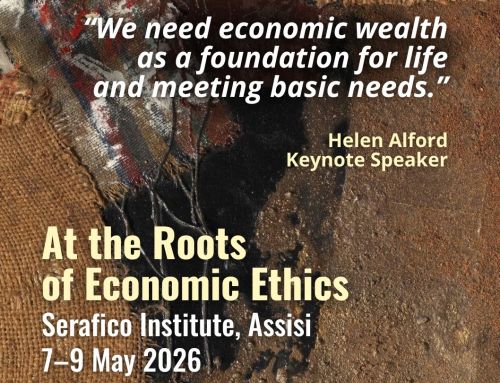
In your opinion, what does it mean to host an academic conference on economic ethics in a place like the Serafico?
Hosting a conference on economic ethics in a venue like the Serafico has a twofold significance. First, it acknowledges that the dignity of every person requires that research remain open. Research, in all scientific fields, is not a neutral fact but a responsibility. It is what allows us to develop knowledge, innovation, and new answers, always within a framework that combines integral human development and the common good. Without this commitment, even progress risks losing its direction.
But there’s a second, equally important meaning: staying at the Serafico means arriving at a frontier, encountering faces, stories, and lives that demand commitment and responsibility. These are the faces that ask us to go beyond what already exists, to open new paths, to imagine possibilities where often only limits are seen.
It is this experience that also gives depth to academic reflection. Because here, thought is not abstract, but is continually questioned by reality.
This is why the Serafico is not just a venue for a conference, but a place that guides questions. It reminds us all that economic ethics cannot be separated from people’s concrete lives and that a more just society can only be built if we are willing to persevere, to open new paths of inclusion and opportunity, starting from those who today risk being left at the margins.
Charism and Institutional Responsibility
How can the Franciscan charism inspire not only spiritual life, but also social and institutional responsibility today?
The Franciscan charism can inspire social and institutional responsibility today because it concerns not only spiritual life, but the very way we view reality and, therefore, how we build institutions. The Franciscan charism calls institutions to allow themselves to be challenged by the concrete reality of people, especially those at risk of remaining invisible.
In this sense, institutional responsibility cannot be limited to efficiency or good organization but must continually address a more radical question: who are we leaving behind? What needs are we missing? Whose lives are missing from our models?
Then there is a second decisive element, which is that of fraternity. For Francis, fraternity is not an abstract ideal, but a concrete form of coexistence, a social proposal. And this, translated into institutions, changes the way authority is exercised, which becomes a service to life.
But there is a third step, particularly urgent today, and that is peace. For Francis, peace is not an abstract idea nor a simple balance to be maintained. It arises from a profound transformation of perspective that recognizes and respects others. Francis does not avoid others, even when they are different or distant: he encounters them, listens to them, and approaches them with humility. Peace, in this perspective, is always a relationship that opens, a space created between people, the possibility of recognizing one another even in their differences.
Finally, the Franciscan charism also requires institutions to adopt an attitude of ongoing conversion: there are no structures that are right once and for all, but there is the ability to listen, to allow oneself to be questioned, and to know how to change when reality demands it.
In this sense and through these paths of fraternity, dialogue, and the ability to stand alongside the most fragile, Francis’s charism remains a public resource today.
A Message for the Participants
As we prepare to meet in Assisi, what would you like conference participants to take with them from this place?
I would like each participant to carry with them the profound value of life — of every human life — and the restlessness of feeling personally responsible for its care.