Rethinking how we measure the economy through fraternity

What is the World Fraternity Index?

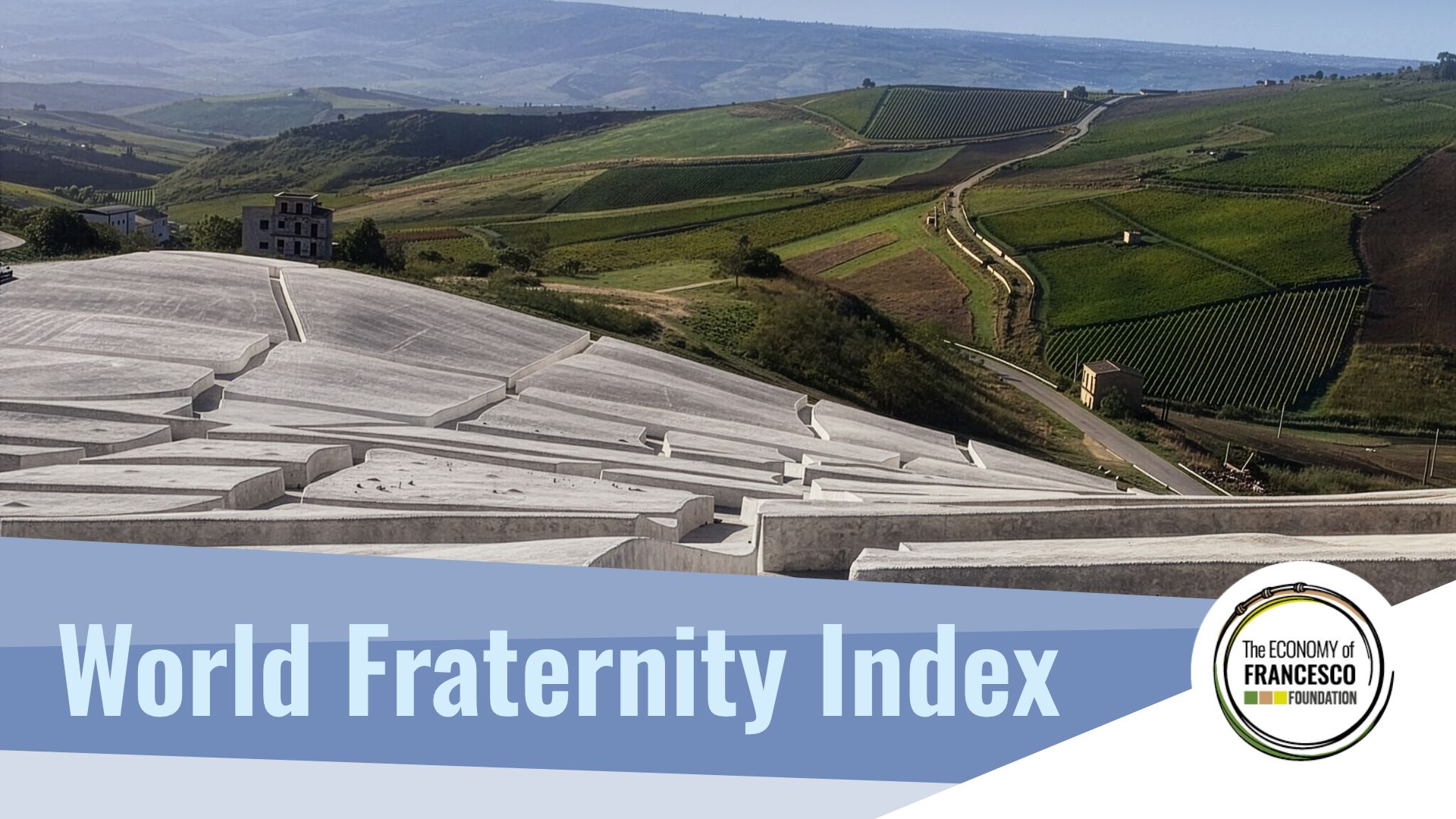
The World Fraternity Index is an initiative of The Economy of Francesco Foundation that seeks to rethink how we understand and measure the economy, moving beyond traditional economic indicators to explore the role of fraternity, human relationships, and social bonds in shaping our societies.

Traditional measures of economic progress often focus on production, income, and growth. While these dimensions remain important, they do not fully capture the quality of human relationships, the strength of communities, or the capacity of societies to foster cooperation, solidarity, and mutual responsibility.

The World Fraternity Index aims to contribute to a broader understanding of economic and social development by exploring fraternity as a concrete and measurable dimension of human life.

Inspired by the vision of The Economy of Francesco, the initiative seeks to provide new evidence and perspectives for building an economy that places people, relationships, and the common good at its center.

If a more fraternal economy is possible, it must also be observable and measurable.

This conviction lies at the heart of the World Fraternity Index.

The World Fraternity Index emerged within The Economy of Francesco Foundation as part of a broader effort to develop new ways of understanding economic progress and evaluating the social dimensions of economic life.

The initiative responds to a fundamental question: How can we measure fraternity, and what can it tell us about the societies and economies we are building?

In 2025, the first edition of the Index explored this question through the analysis of existing international data, introducing an initial framework for examining fraternity across countries.

This first step laid the foundations for a longer-term research initiative, combining economic analysis with insights from the social sciences and encouraging new approaches to understanding human relationships.

Building on the experience of the first edition, the project expanded in 2026 through new academic collaborations and the development of an original international research methodology.

The World Fraternity Index is conceived not as a one-time publication, but as an evolving research effort that seeks to deepen our understanding of fraternity and its relationship with economic and social development.

The World Fraternity Index is an initiative promoted by The Economy of Francesco Foundation, reflecting its commitment to advancing new economic thinking inspired by fraternity, inclusion, and the common good.

The project brings together researchers and collaborators working across different disciplines to explore how fraternity can be understood, observed, and measured.

For the 2026 edition, the initiative has expanded through collaborations with LUMSA University and the HURfuture Research Center, strengthening its academic and methodological foundations. This edition also benefits from the support of the Dicastery for Promoting Integral Human Development.

These partnerships contribute to the development of the research framework, the analysis of international data, and the preparation of the new edition.

The initiative reflects a collaborative approach in which academic research and the vision of The Economy of Francesco Foundation come together to explore new ways of measuring what matters for human and social development.

Promoter: The Economy of Francesco Foundation

Academic and research partners for the 2026 edition:

  • LUMSA University
  • HURfuture Research Center

Research and working group: 

  • Matteo Rizzolli – LUMSA University
  • Pierfrancesco Alaimo Di Loro – LUMSA University
  • Paolo Fantozzi – LUMSA University
  • Paolo Santori – LUMSA University,Scientific Committee The Economy of Francesco Foundation
  • Tony Persico – LUMSA University
  • Luigino Bruni – The Economy of Francesco Foundation
  • Serena Ionta – Scientific Committee The Economy of Francesco Foundation
  • Rita Sacramento Monteiro – The Economy of Francesco Foundation
  • Ricardo Flores Chong – The Economy of Francesco Foundation
  • Tracey Freiberg – Scientific Committee The Economy of Francesco Foundation
  • Maria Jordet – The Economy of Francesco Foundation
  • Valentina Rotondi – Scientific Committee The Economy of Francesco
  • Giorgia Lucchini – Community The Economy of Francesco
  • Dalila De Rosa – LUMSA University

The first edition of the World Fraternity Index, developed in 2025, marked the beginning of an effort to translate fraternity from an ethical and social principle into a dimension that could be studied through empirical evidence.

Using existing international datasets, the research explored how available indicators could contribute to understanding fraternity and social relationships across different countries.

The 2025 edition represented an initial methodological step, demonstrating the potential of using comparative data to investigate dimensions of human relationships that are often overlooked in conventional economic analysis.

It also opened new questions about how fraternity is experienced, perceived, and expressed in different cultural and social contexts.

These questions provided the starting point for the development of the second edition, which introduces new sources of information and a more direct engagement with people’s experiences and perceptions.

The first edition established the foundations for an ongoing research initiative aimed at improving the measurement and understanding of fraternity over time.

Download the World Fraternity Report 2025 here: https://francescoeconomy.org/wp-content/uploads/2026/09/EoF_Fraternity-Index-2025.pdf 

The World Fraternity Index 2026 represents a significant step forward in the development of the initiative.

While the first edition relied on existing international data, the second edition introduces original data collection and an innovative methodology that combines three complementary sources of information.

The objective is to understand not only how fraternity can be observed through existing indicators, but also how people define it, experience it, and recognize it in their everyday lives.

Data collection: An international survey

At the core of the 2026 edition is an original international survey conducted in 18 countries across all continents, with approximately 1,000 respondents per country.

The survey explores how people understand fraternity, toward whom they feel it, and to what extent they perceive it as present in their societies.

It examines relationships with family members, neighbors, strangers, people of different religions and nationalities, as well as feelings of belonging toward one’s country and the wider world.

Some questions draw on the World Values Survey, allowing comparisons with existing international research.

To ensure accessibility and cultural relevance, the questionnaire was translated into more than fifteen languages and reviewed by native-speaking editors.

Fraternity in popular culture

The second component examines how fraternity is represented in popular culture.

Using text-mining techniques, researchers analyze the subtitles of approximately 60 of the most-watched television series in OECD countries.

This analysis explores how words and expressions associated with fraternity appear in widely consumed cultural content, offering insights into how the language of fraternity is reflected in the popular imagination.

Fraternity in the digital world

The third component examines Google search trends to understand how public interest in themes related to fraternity changes over time and across countries.

By analyzing online search patterns, the research explores how these themes emerge and evolve in the digital environment.

Connecting the three perspectives

The originality of the 2026 methodology lies in connecting these three sources through a common analytical framework.

The words and expressions used by survey respondents to describe fraternity provide the basis for interpreting both television subtitles and online searches.

Together, these sources offer three complementary perspectives:

What people say. What people watch. What people search for.

By bringing these dimensions together, the World Fraternity Index 2026 aims to develop a richer and more comprehensive understanding of fraternity across different societies and cultural contexts.

The research seeks to provide rigorous and comparable evidence that can contribute to rethinking how economic and social progress is measured.

Empirical research

Alongside the Fraternity Index, a new empirical research project has been initiated to map existing practices of fraternity around the world. Through qualitative case studies of concrete initiatives, institutions and communities, the project explores how fraternity is experienced and practised in everyday life. It seeks to understand the relationships, mechanisms and conditions that enable fraternity to emerge and flourish, as well as the obstacles that may hinder it. The aim is to learn from existing practices and deepen our understanding of how fraternity can take shape in different social and cultural contexts.

The 2026 edition represents an important milestone in the process of strengthening its methodology, expanding its evidence base, and contributing to international discussions on economic and social development.

Launching of the World Fraternity Index 2026

The launch of the World Fraternity Report 2026, will be taking place on 17 December 2026, from 14:00 to 16:00, at Aula Pia, LUMSA University, Rome. Promoted by The Economy of Francesco Foundation in collaboration with LUMSA University and the HURfuture Research Center.

Building on its first edition in 2025, the 2026 Report presents new research conducted across 18 countries, combining people’s perceptions with cultural and digital evidence to explore how fraternity is experienced and expressed around the world. Join the presentation of the findings and the conversation. 

For those wishing to participate online, registration is available through the following link: https://us02web.zoom.us/meeting/register/vW5Ond8USWWB_8oyk8Ra1A

Looking ahead, the initiative seeks to continue developing its research approach and encouraging dialogue among academic institutions, policymakers, civil society, and communities interested in building a more fraternal economy.

Ultimately, the World Fraternity Index aims to contribute to a broader transformation in how we understand progress: an economy should be measured not only by what it produces, but also by the quality of the relationships it fosters and the opportunities it creates for people to flourish together.

The World Fraternity Index: A Growing Initiative

2025 | First Edition

Launch of the World Fraternity Index and development of an initial approach to measuring fraternity using existing international data.

2026 | Research Expansion

Collaboration with LUMSA University and the HURfuture Research Center. Development of an original international survey across 18 countries and integration of cultural and digital data.

Late 2026 | Publication and Dialogue

Planned presentation of the World Fraternity Index 2026, including events with LUMSA University and other international spaces.

The World Fraternity Report 2026 will be officially launched on

17 December 2026, from 14:00 to 16:00, at LUMSA University (Aula Pia), Rome

in an event promoted by The Economy of Francesco Foundation in collaboration with LUMSA University and the HURfuture Research Center. The event will present the findings of the new research conducted across 18 countries and offer an opportunity for dialogue on fraternity as a dimension of economic and social progress.
Online participation is also possible, with registration available here.

Beyond 2026 | Continuing the Research

Further development of the methodology, exploration of new research opportunities, and continued dialogue on fraternity as a measurable dimension of economic and social progress.