At the Roots of Economic Ethics:
What Questions Are at Stake Today?
by Valentina Erasmo — EoF Foundation Scientific Committee
In recent years, our societies have been experiencing profound transformations, raising new and complex challenges for economists and social scientists, as well as for entrepreneurs, policymakers, and other stakeholders. Among the most pressing — just to name a few — are the increase in geopolitical conflicts with far-reaching consequences for the global economy and international security; the advent and rapid development of artificial intelligence (AI); the persistent tensions in balancing work and care; and the environmental and climate crises.
These challenges cannot be separated from other long-standing structural issues, such as gender inequalities and the socio-economic consequences of centuries of capitalist development grounded in the idea of unlimited growth.
In this scenario, we need to return to economic ethics. Such a shift requires a methodological effort to analyze economic phenomena not only in terms of efficiency or performance, but also in light of their ethical implications and socio-economic consequences.
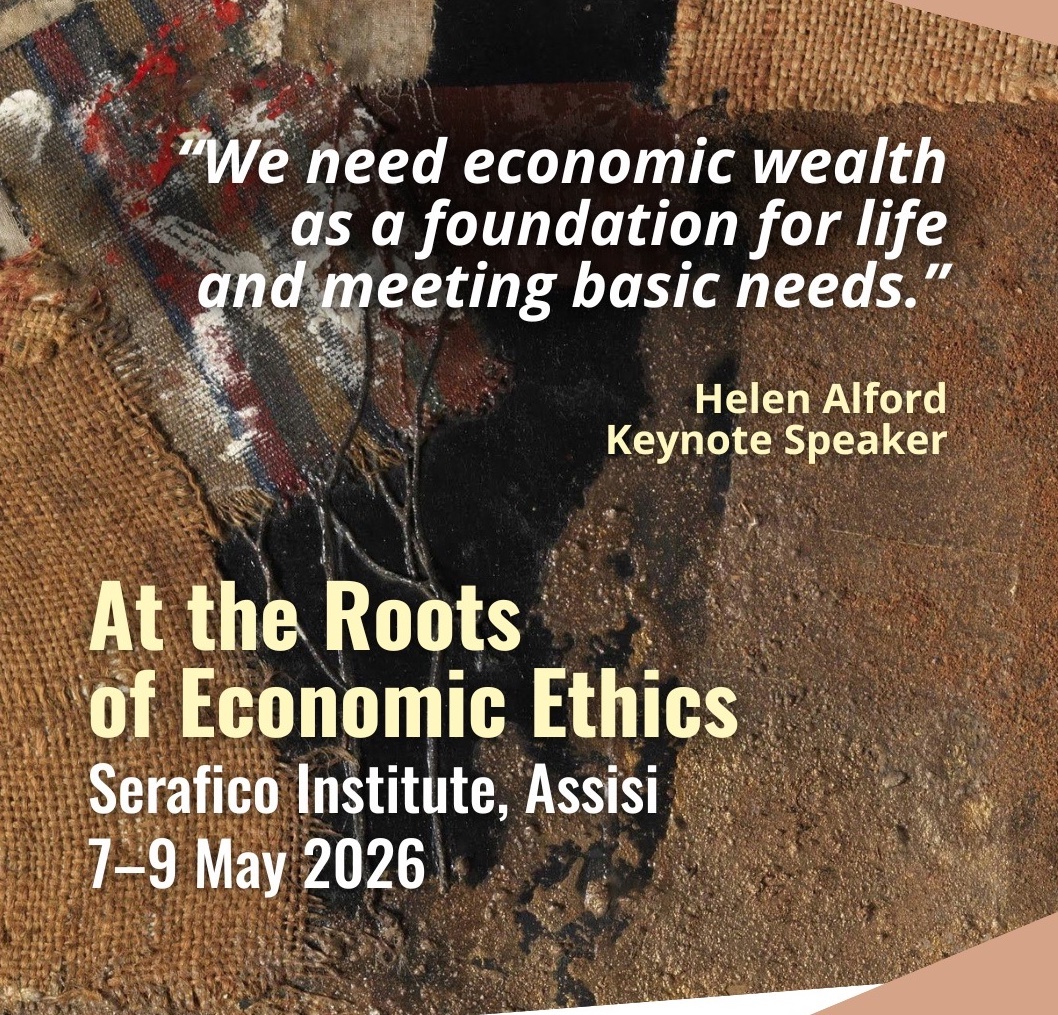
It is precisely from this perspective that the upcoming conference “At the Roots of Economic Ethics” invites scholars and practitioners to reflect on the deeper intellectual and spiritual foundations of economic life.
On the occasion of the 800th anniversary of the death of Saint Francis of Assisi, economists, social scientists, and entrepreneurs from around the world will meet in Assisi this May to reflect on how Franciscan thought may shed new light on interpreting the challenges of our time.
In particular, this is the time to foster a Franciscan approach to economic ethics capable of addressing several fundamental questions:
whether — and how — the spiritual and material dimensions can be reconciled within market economies; how economies of peace can be built in a world increasingly shaped by conflicts and war; and how integral human development might promote more sustainable and inclusive economic paradigms.
Such reflection also invites us to rethink the economy by assigning a more relevant role to social relationships and cooperation over the logic of individualism and unlimited growth, which have often deepened inequalities and reduced human beings to fragmented individuals.
Other issues also deserve attention. Among them is the pivotal role of women — with their “inborn sense of care” — within economic systems primarily oriented toward productivity. Equally pressing is the question of how to safeguard not only ethical values but also the ontological dimensions of human life, such as identity and agency, in an era increasingly shaped by artificial intelligence.
For these reasons, we look forward to welcoming scholars and entrepreneurs in Assisi to discuss these and other socio-economic questions together through the lens of Franciscan normative values. As members of the Scientific Committee, we are honoured to contribute to creating a space for dialogue on how Franciscan economic ethics can speak to the challenges of peace, sustainability, and integral human development.
It is our hope that the discussions emerging from this meeting will not only deepen academic reflection but also inspire new areas of research and dialogue — perhaps even the emergence of new thematic “villages” dedicated to topics such as economic ethics or agency and artificial intelligence.
See you soon in Assisi.