#eofpeople
Human Technologies: New Tools for Good
by Luca Iacovone
published in Avvenire on 10/29/2025

Can there be an artificial intelligence that doesn’t replace, but accompanies? Perhaps yes — when innovation stops focusing only on data and begins again to question itself about ethics. Algorithms no longer decide for us what we see, buy, or think. They remain fast, but cease to be blind. They become tools of discernment, capable of reading complexity without erasing what is human. This is the direction some young people from The Economy of Francesco are working toward: restoring technology to its original purpose — helping people choose well.
Among them, in the United States, Felix Navarrete has created Kairos Compass, an artificial intelligence platform inspired by the Social Doctrine of the Church. Its goal is simple but radical: to translate the principles of dignity, justice, and the common good into operational guidelines for an AI that supports companies, dioceses, investors, and communities in their daily decisions.
“Kairos Compass is an AI co-pilot aligned with Catholic Social Teaching,” explains Felix, “which helps transform theological and social principles into concrete, actionable decisions.”
The project is structured as a system of collective discernment. One module allows users to pose ethical questions and receive answers based on documents from the Church’s social magisterium; another assesses the impact of policies and initiatives according to five criteria: life, dignity, common good, economic justice, and care for creation. A third fosters connections between entities that share the same vision, generating alliances and collaborative projects.
For Felix, whose background bridges philosophy, technology, and social doctrine, it’s not about opposing morality and innovation, but making them dialogue. “Discernment, like innovation, is born from time and community,” he often repeats. Thus, between code and values, Kairos Compass seeks to restore to the economy its spiritual dimension — a technology that doesn’t merely accelerate, but guides.
Thousands of kilometers away, in a country torn by war, Vitalii Pazdrii shares the same inspiration: to use technology to help people choose. A professor of economics at the National University of Kyiv and a member of The Economy of Francesco, he coordinates for Caritas-Spes Ukraine a project introducing entrepreneurship and financial education in secondary schools, even in the most vulnerable areas of the country.
At the heart of the program is the simulation-based learning method — an educational technology that combines play, virtual reality, and experiential learning.
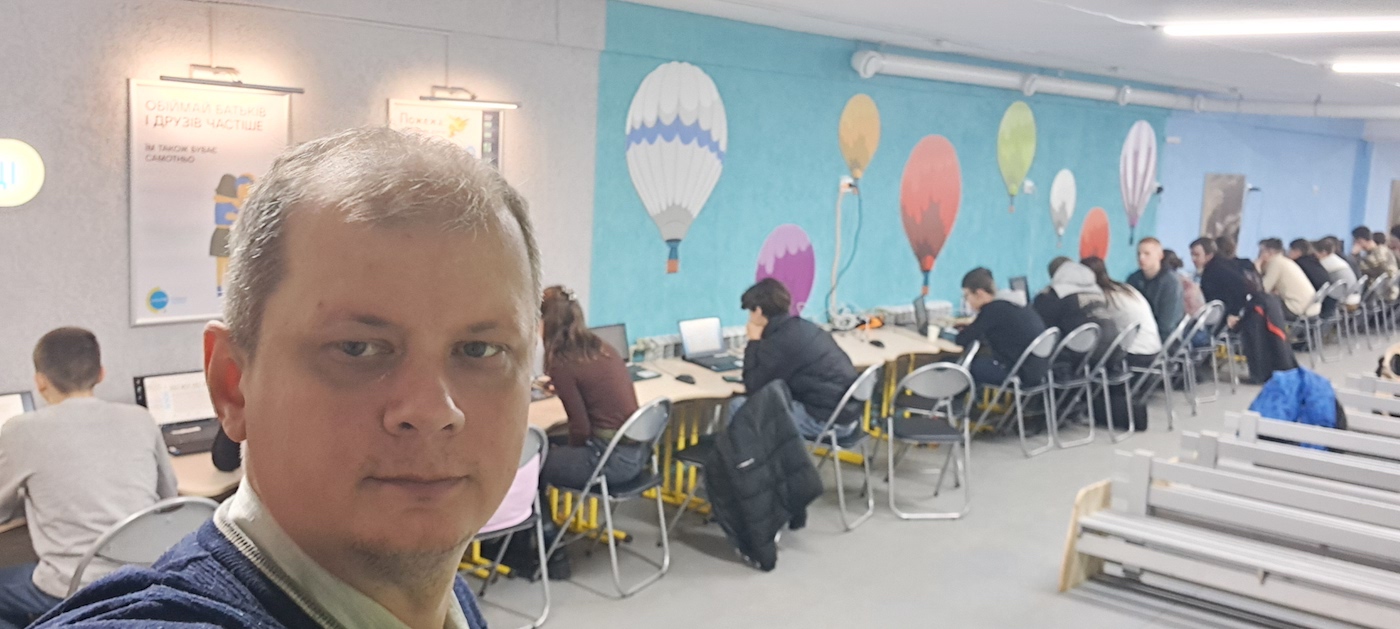
Students simulate complex economic scenarios, make decisions, face consequences, and learn to cooperate and manage risk. It’s a way to learn business as responsibility, not competition, and to discover that the economy can be a place of freedom and trust even amid fear.
A national survey conducted in 2024 showed that over 65% of participants improved their ability to navigate between school and work, and 90% of trained teachers feel more prepared to promote entrepreneurial and civic skills.
“We don’t just want to train entrepreneurs, but free people,” explains Vitalii.
In Ukraine, technology is not a refuge but a path to keep growing together, even when war tries to interrupt hope.
Between Dallas and Kyiv, between an algorithm and a classroom, the same trajectory unfolds: that of an economy putting the human person back at the center. Not an innovation that replaces, but one that accompanies. Not merely technique and accumulation, but freedom and hope — made possible also through technology.
On the path toward Restarting the Economy, the global gathering promoted by The Economy of Francesco to be held at the end of November in Castel Gandolfo, Italy, the experiences of Felix and Vitalii will contribute to the global dialogue on technology, justice, and dignity. The summit, inspired by the 2025 Jubilee and the 800th anniversary of the Canticle of the Creatures, will bring together hundreds of young economists, entrepreneurs, and researchers to envision an economy of breath — where even machines become instruments of humanity.
—
Discover the other stories:
Caring Is Already Doing Economy