Poverty and Public Policies:
Esther Duflo Meets the Economy of Francesco
by Paolo Santori – Tilburg University
published in Avvenire on 11/12/2025
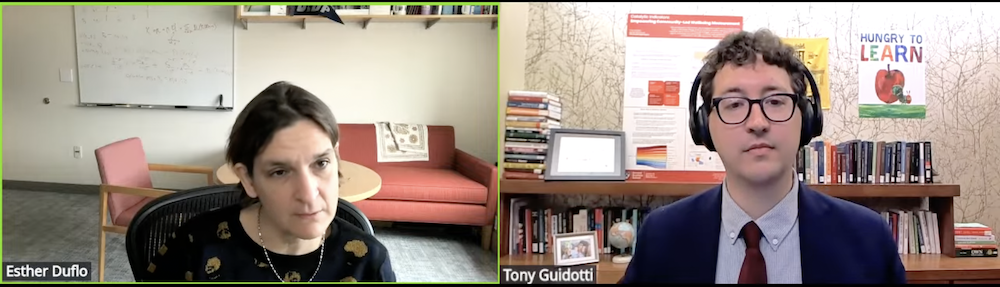
November is the month of the international Economy of Francesco (EoF) event. In preparation, the community invited Esther Duflo, 2019 Nobel Prize laureate, to speak about poverty, economic science, and public policy. The starting point is simple and intentionally not innovative: poverty is a social problem, and we must deal with it. But how? Two paths emerge.
One envisions institutions capable of “taking care” of people not only as policy targets but as relational beings. It dreams of systems that do not merely treat symptoms, but rethink structures. In a world marked by what many call a polycrisis (climate, conflicts, pandemics), the question is: how can we rethink methods and institutions to build resilience and not just average effects? Those who work in EoF recognize this tension: the desire for deep reforms that transform education, health care, and social protection so they can support communities in critical moments.
The second path, chosen by Duflo, is the one that gets its hands dirty. Small interventions—contextual, measurable. Not a perfect society, but concrete changes: educational programs tailored to children’s abilities, microcredit that doesn’t humiliate those without collateral, health campaigns that reach the invisible. A path that requires humility: observe, evaluate, correct.
To some, this may seem too little. But the experimental approach argues that systemic change can also arise from local successes that generate shared knowledge. Here another point dear to Duflo enters: dignity. Not only measurable outcomes, but the ability to capture respect, meaning, and significance within economic metrics. Is it possible to do so without losing rigor? Perhaps this is the next frontier of evidence-based policies: measuring not only what works, but how it makes people feel.
Into this dialogue enters the perspective of the Economy of Francesco and the magisterium that inspires it. Pope Francis in his teaching, and Pope Leo XIV nella Dilexi te, remind us that there is a “bad poverty” made of misery and injustice, and a “good poverty,” freely chosen as a path of fraternity and freedom. Poverty is not an individual fate but a relationship—born of collective choices and unequal distributions. This vision resonates with Duflo’s work: no public policy is effective if it does not recognize the dignity and voice of those who experience it, and if it does not address the relational roots of exclusion.
The final lesson is perhaps one of style. Duflo began her talk by saying: “Now I will tell you what we were right about, and what we were completely wrong about.” An invitation to humility—scientific and human. A reminder that without listening, revision, and sharing of power, neither science nor economics can truly serve life. And, looking at the imbalance of Nobel laureates in economics (3 women out of 96 men), a sign that institutions and knowledge must also be rethought by changing who builds them.