Why is fraternity more radical than it sounds?
As we come closer to the EoF International Summer School that will take place in Germany, it is worth sharing some thoughts from two of those who will participate in this space, both active members of the Economy of Francesco community, with very different profiles but shared values, working for the humanisation of the economy and for fairer realities from their own spaces and their communities at different levels.
This 2026 edition is the first to take place outside of Italy. A natural step in the development and growth of the international community, which testifies to the growing support of partners and friends. This event that will gather over 20 nationalities in the cities of Osnabrück and Mettingen, will take place between the 29th of August and the 3rd of September in two venues closely aligned with the EoF values and activities. In Osnabrück, we will gather at the Innovatorium, a development project based in a historic former train depot that has been transformed into a center for innovation, creativity, business and community development. Thereafter, in Mettingen, we will be at Draiflessen, a space that cultivates knowledge, academia and innovative thought while preserving history.
The main topic of the Summer School will be The Economics of Fraternity and how this can become a real force in economic life at all levels. Thus, it aptly gathers changemakers, entrepreneurs and academics.
Having such a diverse group provides a fertile ground for innovation and advancement in dialogue. The participants will be joined by different senior panelists and keynote speakers, including Sister Helen Alford, Luigino Bruni and Felix Osterheider, among others. They will guide, accompany and learn alongside all the participants as a collective, as a community.
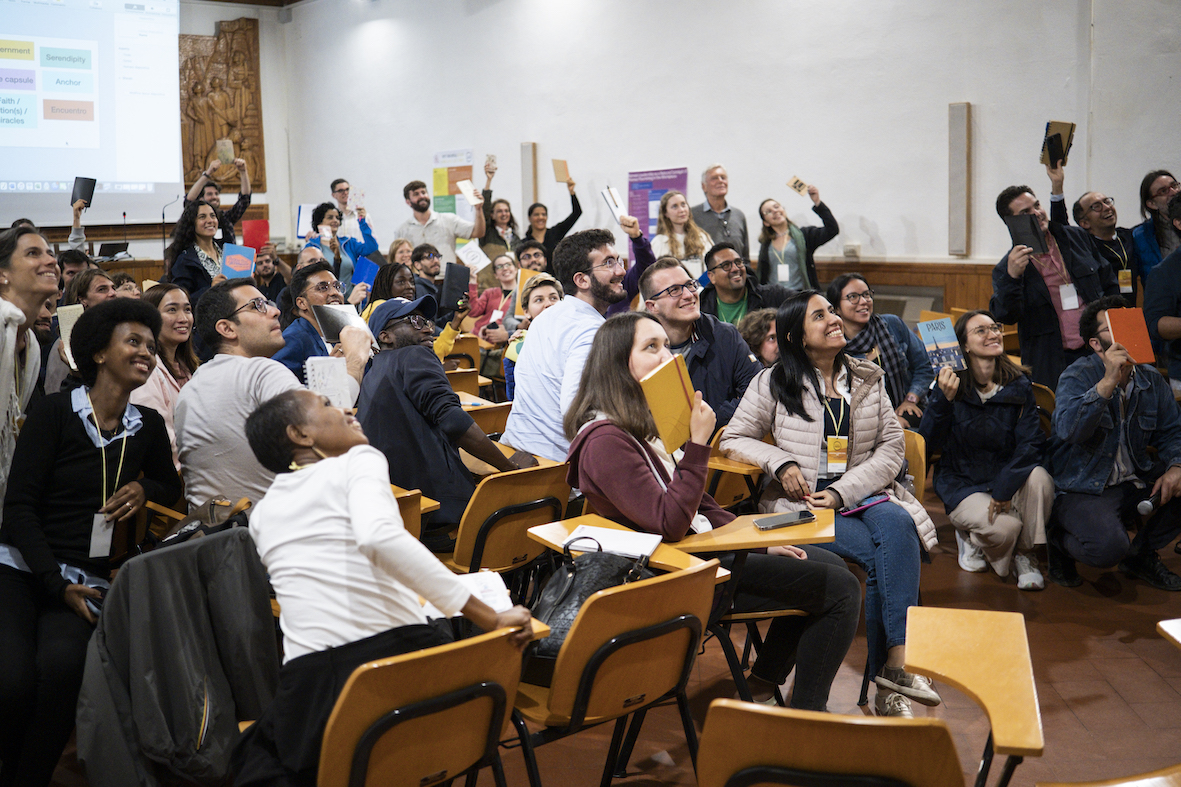
The EoF Foundation seeks to contribute to a paradigm shift in our economic systems by promoting an economy that upholds the dignity of every person, cares for our common home and helps restore those dimensions of economic life that have been neglected, distorted or devalued, such as fraternity, gratuitousness, care and the common good. It is through these efforts that fraternity becomes a transversal topic and vision. Yet, it can take different meanings depending on the contexts, cultures and histories. The EoF Foundation has proposed a shared definition based on the EoF Fraternity Report. It is, however, the members of the community who truly bring this shared definition to life, particularly within the fraternal processes of their work. The strength of EoF therefore lies precisely in the individual efforts of each of its members, brought together in pursuit of a greater goal within their communities, in their own square meter.
We have asked two members of the EoF community who will participate in the next EoF International Summer School — Sophie Maeva (Ireland) and Nishita Dsouza (USA) — the following question: Why is fraternity more radical than it sounds?
Sophie Manaeva is a researcher for the Jesuit Centre for Faith and Justice, focusing on environmental issues, economic justice and migration. She is currently working on initiatives to engage ecclesial communities in new cooperative and Community Wealth Building projects in Dublin’s north inner city. Alongside her research, Sophie is completing her dissertation for an M.Phil in Theology and Social Justice at Trinity College Dublin. She is also a co-organiser of the Economy of Francesco Ireland Hub.
“As I write, Irish news headlines are about yet more anti-immigrant attacks and intimidations. It is painful to see this lack of fraternity — this rejection of people ‘unlike us’. Conversations against immigration frequently end up incorporating some kind of economic criticism to justify racism: concerns about employment or ‘wasteful’ State spending on support for asylum seekers. It is, of course, a thin cover for prejudice, but it remains a regular part of such discussions. As economic inequality and hardship grows, people seek a scapegoat. Picking on those already marginal in society is as easy as it is abhorrent. And so, the dignity of others becomes collateral so long as the individual, so long as I am protected from privation.
Valuing fraternity rejects thinking this way. It remains a radical proposal in our economic and social life because it does not subordinate human ends for economic ones. Two experiences in my past year of work and study come to mind when I think of fraternity.
The first project I worked on as a research assistant for the Jesuit Centre for Faith and Justice was on the importance of faith communities for migrants in the inner city. We found, despite the skyrocketing rents and lack of appropriate space in Dublin, almost fifty faith groups in one small area. They are vibrant spaces of worship that welcome and support newcomers. Moreover, the fraternity displayed between distinct communities is remarkable. Established churches sometimes host as many as three minority faith groups on their premises. In one instance, a person from a Pentecostal church that met in a garage told me that for weddings and funerals, they ‘reach out to [their] Catholic friends.’ Being given a space to worship is a lifeline for many people. Where the State failed to recognise this, the slack was picked up by these many faith communities.
In the course of my studies this year, I volunteered at a homelessness charity. We served breakfast to anybody who came into the ‘café’. Over and over, I would witness individuals utterly forgotten by wider society. In this space, I had the opportunity to have conversations with and get to know some of them. Reflecting back, the people I met were economically insignificant. They were unemployable, due to mental illness, addiction, asylum applicant status, or simply lack of fixed address. They did not contribute to GDP. They did not own property or rent. In our present economy, this renders them invisible and unimportant. Cast out from the economically productive human family, fraternity was shown to them only through the efforts of this overburdened charity.
It has become normalised to think about our moral obligations in terms of statistics, cost and efficiency; and this makes it all the easier to ignore the humanity of others. Fraternity resists this dehumanisation. In these two experiences, marginal members of society were shown love, and their unique contributions recognised and valued. Recognising someone as a sister or brother guards against the instrumentalisation of the human person, so frequent in a relentless, technocratic economy. Fraternity, and a willingness to view the most frail members of the human family as the most important (1 Corinthians 12:22), challenges normative economistic thinking. Welcoming new neighbours and taking care of them is not something that should ever be approached with miserliness. This is the radical proposal of an economy based in fraternity.”
Nishita Dsouza is an Assistant Professor of Social and Behavioral Science at the Brooks College of Health at the University of North Florida. Her focus is on developing interventions that advance health equity and improve quality of life. She brings expertise in urban health, systems science, implementation science and measurement, with a background in survey data analysis and community-engaged research alongside Black and Latino populations.
“When I hear the word ‘fraternity’, what comes to mind is houses filled with rambunctious people who party copiously. Digging deeper, though, there is something admirable about the community that people living in a fraternity experience. As a community-based participatory researcher, the concept of community is near and dear to my heart. Growing up in a megacity in India, it was people and our tight-knit relationships that gave us life. Moving to the US, it was the immigrants or minorities, the ones preserving their culture in a diverse country, that were my community. I grew up traversing multiple communities, and bringing a different part of myself, a different facet of my identity into each of these spaces.
My life changed as an undergraduate student, when I was blessed to join the community of people attending Georgetown University, a Jesuit school located in Washington DC. Georgetown does not allow for fraternities, because of the Jesuit value of openness and inclusion, which are contrary to the way fraternities are set up. One of my first experiences at Georgetown was a program called ‘Breaking the Bubble’. The premise was simple: take students on a day trip to explore the greater Washington DC area, giving them a taste of what is outside of the ‘campus bubble’. I jumped at the opportunity to explore, but I didn’t realize what a life-changing journey I was in for. Our bus drove past the National Mall, the monuments, and the postcard-version of Washington DC, over the Anacostia River. We spent the day in community with some of the poorest people living in Washington DC, a neighborhood that has a long history of racism and inequities. This program, while not intending to be radical in nature, radicalised me and opened my eyes to caring about people beyond just those in my immediate network. At the time, there wasn’t a great word or definition for what I was experiencing, so I latched on to the concept of ‘community’.
My life changed yet again in November of 2025, when I was blessed to attend the EoF Global Event in Castel Gandolfo, in Italy. It was there that I heard the following quote: ‘Community is caring about people who you share something with. However, fraternity is providing care to someone who is not in your community’. I realised that the concept I am chasing was an evolution of the past community, into how we can simultaneously live in a ‘bubble’ but also cultivate environments where everyone can have their own bubbles, or we can move from bubble to bubble, respecting our shared humanity and valuing life.
The most radical aspect of the concept of fraternity is this: the true collective strength of life and living beings, and the truly infinite capacity we have to love one another. Fraternity is a radical concept in that it seems impossible or unfeasible, but I strongly believe that we are capable of designing systems capable of cultivating this collective strength. I look forward to the EoF International Summer School to learn more about fraternity. As a researcher, I want to learn more about how to define and measure fraternity. As an entrepreneur, I imagine that I would create well-suited solutions on fostering or increasing fraternity. As a changemaker, I hope that I would codify and scale up successful solutions that cultivate and preserve fraternity, for generations to come.
As the days approach for our gathering in Osnabrück and Mettingen, Sophie’s and Nishita’s reflections remind us why we chose The Economics of Fraternity as our focal point. Fraternity is not a passive sentiment or a mere theoretical concept; it is a disruptive, radical force that challenges the foundations of a technocratic economy that too often treats human beings as invisible statistics. Whether it be opening the doors of a local church to a migrant community in Dublin or stepping outside of a university bubble to stand in solidarity with the marginalised in Washington DC, fraternity forces us to shift our economic priorities from efficiency to humanity.
The International Summer School 2026 will serve as a space of encounter for these ideas and shared paths of work. We are not just analysing the problems of our current system, we are actively designing the solutions. As an international summer school expanding its footprint beyond Italy for the first time, our goal remains clear: to aggregate the individual efforts of our members in their own square meters into a collective strength capable of transforming the global economic paradigm. Together, in the historic and innovative spaces of Germany, we will continue to work for fairer realities, proving that an economy rooted in fraternity is not only possible, but urgently necessary.
Ultimately, the core mission of our gathering lies in the profound evolution of thought that Nishita beautifully captures: “Community is caring about people who you share something with. However, fraternity is providing care to someone who is not in your community.” This is the true frontier of the Economy of Francesco. In a world that constantly encourages us to retreat into our own isolated bubbles, our Summer School is an invitation to burst them wide open. By translating this radical care into concrete economic systems, metrics and real-world solutions, we are proving that our capacity to love and support one another is infinite. From the historic spaces of Osnabrück and Mettingen, we step forward as architects of a new reality, ready to build an economy where no one is left invisible and where fraternity becomes the heartbeat of our common home.