The 2025-26 EoF Academy Academic Year
Has Concluded
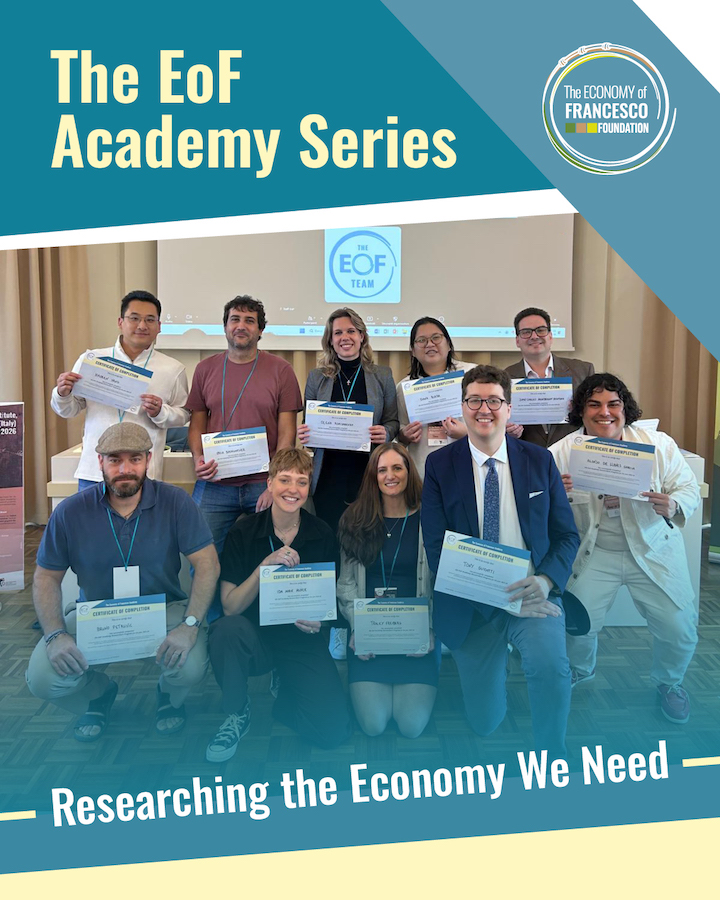
A shared journey comes to a close. And another begins.
During the pre-conference of At the Roots of Economic Ethics, the fellows of the second edition of the EoF Academy received their certificates after two years of research and study. Coming from different countries and disciplines, they have formed a community of young scholars committed to rethinking economic life in the light of fraternity, care, and the common good.
Their presence in Assisi these days is not only the conclusion of an academic path, but a sign of a new generation seeking to reconnect economic thinking with ethical and social questions.
Congratulations to all the fellows of the second edition of the EoF Academy!
As part of this journey, we are launching the EoF Academy Series – Researching the Economy We Need, a new editorial series dedicated to sharing the research projects developed by the Fellows throughout their Academy experience. Over the coming weeks, new ProView articles and research papers will be gradually published, offering insights into the questions, challenges and proposals explored by this new generation of scholars.
More than a collection of academic outputs, this series reflects the EoF Academy’s commitment to fostering research that engages with the social, environmental and ethical challenges of our time, while contributing to the search for a more fraternal, sustainable and inclusive economy.
We invite you to follow the series and discover the ideas emerging from the Fellows’ work.
Discover below the research projects completed by the Fellows in May 2026. New articles and papers will be added regularly over the coming weeks.
MANAGEMENT, INDUSTRIAL AND INNOVATION PERSPECTIVE:
Alessandra Anna Palazzo
Immigration and Economic Growth: Evidence from Chile
Elisa Fernanda Barreto Perez
The rules were clean. The outcome wasn’t. What two Mexican states teach us about power and reciprocity
Ximena Gomez Lavi
Can climate action be driven by humanity and ethics? An exploratory study of the motivations of Peru’s most influential climate leaders
Tatiana Vasconcelos Fleming Machado
Labor Quality and the Green Industry: The Path to a Just Transition in Brazil
INEQUALITY AND PUBLIC POLICIES:
Erick Baumgartner
The Electoral Effects of Conditional Cash Transfers
Raphaelle Aulagnon
What Students Are Willing to Trade for a Politically Aligned Campus
Francesco Romagnoli
How Fascist Italy Distributed Land in the Pontine Marshes: Rules, Reality, and the Limits of Planning
Haoran Yang
When Reducing Food Waste Leads to Overeating: Understanding an Overlooked Household Trade-off
Isabella Sanchez Vargas
Making Hidden Vulnerabilities Visible: From Multidimensional Child Poverty to Environmental Health Risks
NEW ECONOMIC PERSPECTIVES:
Tony Guidotti
Ownership and the Humane Economy
Bruno Petrušić
Biblical and Theological Roots of Steward-Ownership
Isaac Stanley
Between “reality on the ground” and a “new humanism”: the anthropology of Mamadou Dia
Juan Carlos Mondragon Quintana
Data Capitalism and the Common Good: What a Los Angeles Jury Got Right
Andrei Thomaz Oss-Mer
Alonso de Llanes Garcia
Caring for Creation Together: When Stewardship Becomes a Spiritual Practice
FEMINIST ECONOMICS:
Diana Rueda
Antônia Larissa Alves Oliveira
Does Mineral Wealth translate into better Living Conditions for Women in the Brazilian Amazon?
Olena Komisarenko
The Role of Interreligious Dialogue in the Labor Market Inclusion of Migrant Muslim Women in Italy: the Case of the Community of Sant’Egidio
Bárbara Nascimento Flores
Restoring the Earth, Restoring Life: Indigenous Knowledge, Regenerative Economies, and Capacities for Buen Vivir in Times of Crisis
Ida Marie Munck
Intellectual Care: The Practice of Care Ethics in Higher Education
Tracey Freiberg
Good Debt, Bad Debt: How Paid Family Leave Shapes Intra-Household Borrowing After Childbirth